
Multi-Tenant Buildings & Pest Spread: Why One Unit Impacts the Entire Property
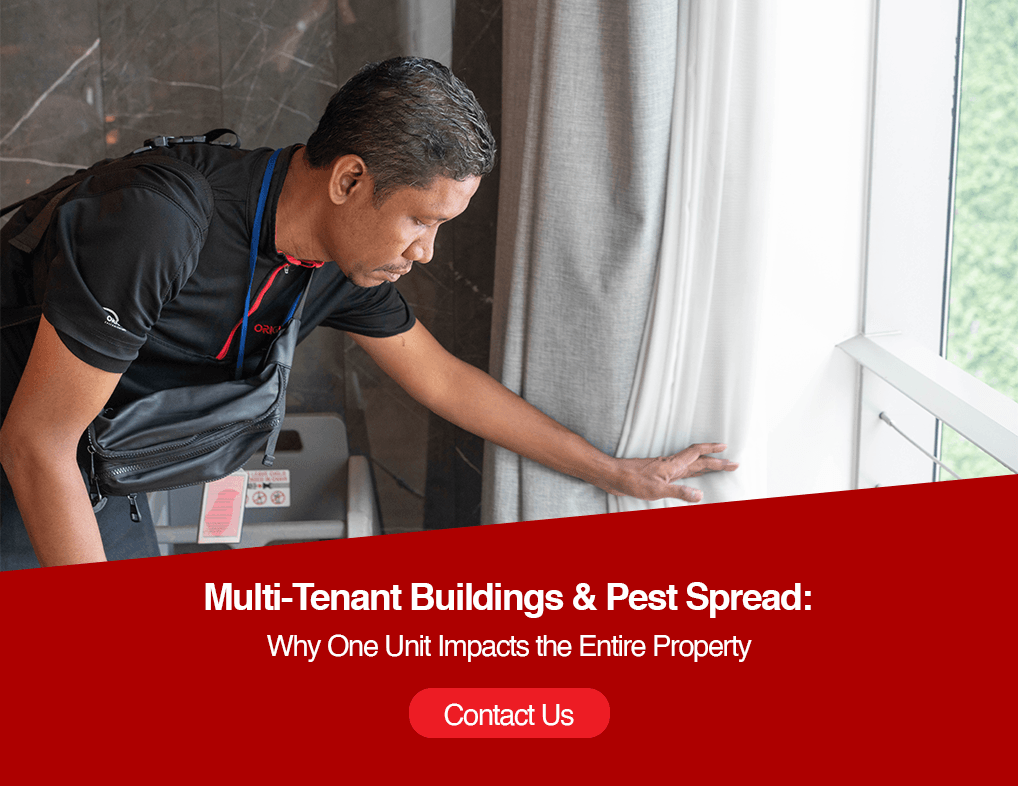
In a multi-tenant building, a pest problem in one unit is never truly one unit’s problem. Cockroaches, rodents and ants move freely through shared walls, ceiling voids, pipe risers and ducting the building’s hidden infrastructure becomes their highway network.
Once a pest population establishes itself anywhere in the structure, it will follow heat, moisture and food odours into neighbouring flats, common corridors, bin rooms and car parks. What starts as a single complaint can escalate into a building-wide infestation if it is not addressed at the source, and across the whole property.
How Do Pests Spread Between Units in a Multi-Tenant Building?
Pests spread between units by exploiting the structural connections that all multi-tenant buildings share. These routes are largely invisible to residents but are well-used by pests.
Common pest travel routes include:
- Shared wall cavities and ceiling voids cockroaches and rodents nest in these spaces and move laterally across multiple units without ever entering an open room
- Service risers and plumbing runs pipes penetrate every floor, and gaps around pipe penetrations are among the most common entry points for cockroaches and rodents
- Ducting and ventilation systems air movement carries pest pheromones and provides direct physical routes between kitchens and bathrooms across units
- Lift shafts and stairwells rodents are capable climbers and use vertical shafts as efficient transit routes between floors
- Bin rooms and refuse areas these are primary attractants; a poorly managed bin room draws pests in and distributes them outward into the wider building
Pests follow three primary signals: warmth, moisture and food odour. Any unit or communal area that provides one or more of these signals becomes a destination, regardless of how clean adjacent units are.
Why Does One Untreated Unit Undermine the Whole Building?
A single untreated harbourage point acts as a source population that continuously re-seeds the rest of the building. Treating other units without addressing the source produces temporary results at best.
Even well-maintained flats are vulnerable when neighbouring units have:
- Poor refuse handling or food waste left accessible overnight
- Clutter that provides undisturbed harbourage for cockroaches and rodents
- Leaks, condensation or poorly ventilated bathrooms and kitchens that sustain moisture-dependent pest activity
- Unsealed gaps around pipe penetrations, door frames or skirting boards
When pests face treatment pressure in one area, they retreat into inaccessible voids and re-emerge once conditions are safer. This is why reactive, unit-by-unit pest control produces repeated complaints and escalating costs. The infestation is never fully eliminated it is simply displaced.
What Does Effective Pest Control for Multi-Tenant Buildings Look Like?
Effective building pest control is coordinated, property-wide and preventive not reactive and piecemeal. A building-wide programme addresses both active infestations and the structural conditions that allow pests to persist.
The key components of a coordinated building pest management programme are:
- Planned inspections across all units and communal zones not just the unit where complaints originate
- Targeted treatment of high-risk areas including bin rooms, service risers, ground-floor entry points and roof voids
- Structural prevention sealing cracks, closing gaps around pipe penetrations, repairing leaks and fitting door sweeps
- Refuse management improvements ensuring bin areas are cleaned regularly and waste is stored in sealed containers
- Resident cooperation protocols clear reporting processes and resident awareness reduce the lag between infestation onset and intervention
- Ongoing monitoring smart surveillance tools detect activity early, before populations grow large enough to spread
ORIGIN Exterminators applies this building-wide approach using science-backed methods and technology such as the RATSENSE® smart rodent surveillance system, which enables continuous monitoring across a property without requiring constant manual inspections. This shifts pest management from reactive to proactive catching problems at the source before they become shared ones.
Key Takeaways: Pest Spread in Multi-Tenant Buildings
- Pests treat multi-tenant buildings as a connected system, using shared infrastructure to move freely between units, floors and communal areas.
- One untreated unit or harbourage point is sufficient to sustain and re-seed infestations across an entire property, making unit-by-unit treatment ineffective on its own.
- Effective building pest control requires coordinated inspections, targeted treatment, structural prevention and resident cooperation managed as a single, property-wide programme.
- Proactive monitoring using smart surveillance technology detects pest activity early, reducing the cost and disruption of large-scale infestations.
- Property managers who implement a unified pest management programme protect every unit, maintain hygiene standards and reduce long-term remediation costs.
| Aspect | ORIGIN Exterminators (Building-Wide Programme) | Unit-by-Unit Reactive Treatment |
| Scope of inspection | ✔️ All units, communal areas and structural voids assessed together | ✘ Limited to the unit raising the complaint |
| Source identification | ✔️ Root cause located and treated, not just symptoms managed | ✘ Source population often remains untreated in adjacent areas |
| Monitoring technology | ✔️ RATSENSE® smart rodent surveillance for continuous, building-wide detection | ✘ No ongoing monitoring between complaint-driven visits |
| Re-infestation risk | ✔️ Significantly reduced through structural prevention and coordinated treatment | ✘ High pests retreat and re-emerge once treatment pressure lifts |
| Resident and management coordination | ✔️ Structured reporting processes and resident protocols included | Partial relies on individual residents to report independently |
| Long-term cost efficiency | ✔️ Fewer repeat call-outs, lower escalation costs over time | ✘ Repeated treatments required as infestation cycles continue |
The Right Approach: Treat the Building, Not Just the Unit
Pest control in a multi-tenant building works when it is treated as a shared responsibility across the whole property. A single unit receiving treatment while surrounding harbourage points go unaddressed is not a solution it is a delay. The structure itself needs to be assessed, monitored and maintained as one system. That means coordinated inspections, targeted intervention, structural sealing and technology-assisted monitoring working together. When every part of the building is covered, every resident benefits and the cycle of repeated complaints stops.
If your building is experiencing recurring pest issues, contact ORIGIN Exterminators for a building-wide assessment. We identify the source, treat the problem properly and put a programme in place to keep it from coming back.
Frequently Asked Questions
Q: Can a clean flat still get cockroaches if a neighbouring unit has an infestation?
A: Yes cockroaches move through shared wall cavities, pipe gaps and ventilation systems regardless of how clean an individual unit is. A well-maintained flat offers no barrier if an untreated harbourage exists nearby.
Q: Why do pest problems keep coming back in the same building after treatment?
A: When only the affected unit is treated, the source population in adjacent voids or neighbouring flats remains intact and re-seeds the building once treatment pressure lifts. Lasting results require addressing the entire property, not just the complaint point.
Q: Who is responsible for pest control in a multi-tenant building: the landlord, the property manager or the tenant?
A: Responsibility typically sits with the property manager or building owner for communal areas and structural pest routes, while tenants may be responsible for conditions within their own unit. In practice, effective control requires cooperation from both parties.
Q: How does ORIGIN Exterminators handle pest control differently for multi-tenant buildings?
A: ORIGIN Exterminators applies a coordinated, building-wide programme that covers all units, communal zones and structural voids using the RATSENSE® smart rodent surveillance system to monitor activity continuously rather than waiting for complaints. This proactive approach identifies the source and prevents re-infestation across the whole property.
Q: What are the highest-risk areas for pest spread in an apartment block?
A: Bin rooms, service risers, pipe penetrations and ground-floor entry points are consistently the most active pest transit and harbourage zones in multi-tenant buildings. These areas need targeted treatment and regular monitoring as part of any effective programme.
Q: Does treating one flat for rodents stop them from spreading to other units?
A: No rodents simply retreat into wall cavities, lift shafts or neighbouring units when treated in isolation, then re-emerge once conditions settle. Building-wide treatment combined with structural sealing is required to break the cycle.
Q: How can a property manager detect a pest problem before residents start complaining?
A: Smart surveillance technology, such as continuous rodent monitoring systems, can detect activity in high-risk zones early well before populations grow large enough to spread into occupied units. Scheduled building-wide inspections of communal areas and voids also catch infestations at the source.

