
How Outdoor Spaces Fuel Indoor Pest Infestations
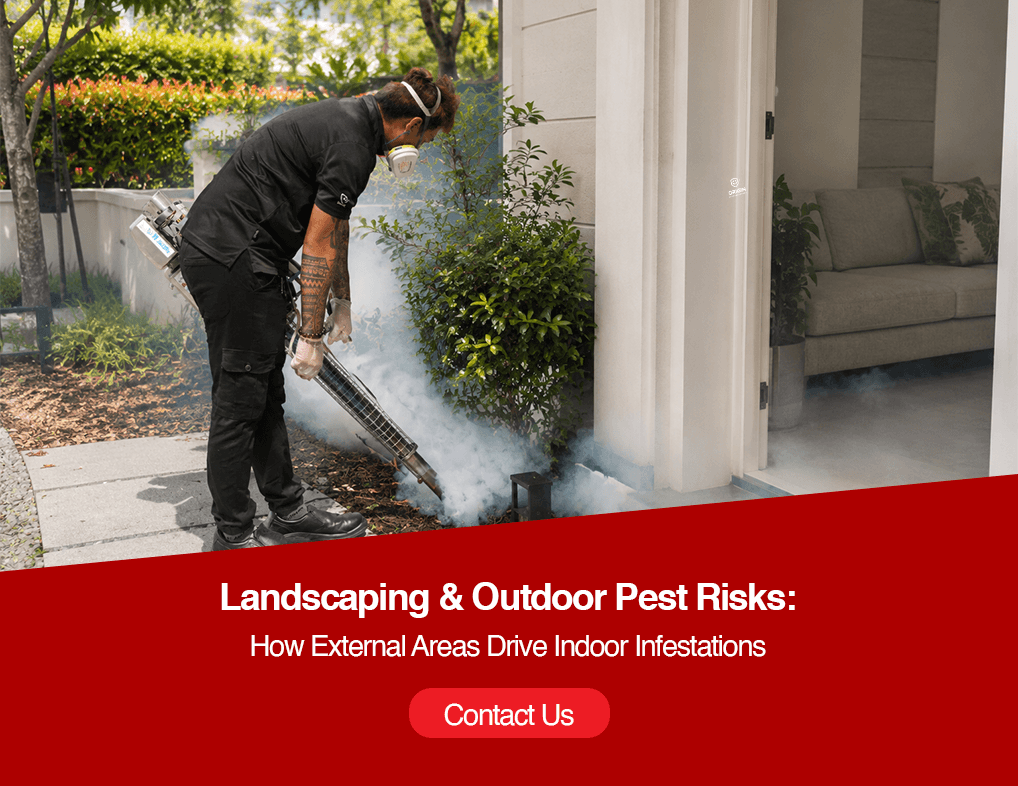
Most pest problems don’t start inside your home or building they start outside. Overgrown gardens, stagnant water, decaying plant matter, and poorly maintained outdoor areas create ideal conditions for pests to breed, gather, and eventually move indoors. If you’ve been treating indoor infestations without addressing what’s happening in the garden or around the perimeter, you’re solving the wrong problem.
The connection between outdoor conditions and indoor pest pressure is well-documented and consistently underestimated. From mosquitoes breeding in plant saucers to rodents nesting in dense shrubs along a fence line, external environments are where infestations begin not where they’re discovered. In Singapore’s tropical climate, where warmth and humidity are constants rather than seasons, this dynamic plays out year-round with particular intensity.
This guide walks through the key outdoor risk factors, the pests they attract, and what targeted, science-led pest management looks like when it starts where it should at the perimeter. Whether you manage a family home, a commercial property, or a food-sensitive facility, your outdoor space is either working for you or against you. Understanding that distinction is where effective pest control begins.
Why Outdoor Areas Are the Real Source of Most Infestations
Indoor pest problems are rarely random. In most cases, pests are responding to conditions that exist outside the building food sources, shelter, moisture, and warmth that draw them progressively closer until they find a way in. Landscaping features like mulch beds, dense ground cover, compost heaps, and ornamental water features all create micro-environments that support pest populations. Once established near a structure, it becomes a matter of time before they breach the interior. Addressing the indoor problem without tackling the outdoor source is like mopping the floor while leaving the tap running.
Properties with poorly maintained gardens or neglected perimeter zones consistently show higher indoor infestation rates. This isn’t coincidental it reflects the basic behavioural patterns of the pests involved. Cockroaches, rodents, mosquitoes, and termites don’t make arbitrary decisions about where to establish themselves. They follow environmental cues: moisture, warmth, food availability, and shelter. When those cues are concentrated in an outdoor zone directly adjacent to a building, the building becomes the natural next destination. Effective pest management identifies and eliminates conditions at the point of origin outside the building before pests ever reach the threshold.
The Pathway from Garden to Interior
Pests don’t appear indoors by chance they follow predictable routes that can be mapped, monitored, and interrupted. Rodents travel along wall lines and fence bases, using dense vegetation as cover. Cockroaches move through drainage channels and gaps around pipe entry points. Ants track moisture gradients from soil into wall cavities, following trails that can extend from a garden bed directly into a kitchen. Mosquitoes don’t travel far from their breeding sites, which means a garden with standing water puts every room within 50 metres at meaningful risk.
Identifying these pathways requires a systematic inspection of the building’s exterior not just a scan of the interior. ORIGIN’s Integrated Pest Management (IPM) process maps pest entry vectors as part of its initial assessment, connecting outdoor conditions directly to indoor risk. This approach treats the garden, drainage lines, and perimeter structures as primary data points rather than background context. Understanding how pests move from outside to inside is the foundation of any management programme that actually holds.
How Singapore’s Climate Amplifies Outdoor Pest Pressure
Singapore’s humidity rarely drops below 70%, and average temperatures sit between 25°C and 32°C year-round. These are near-perfect conditions for mosquito larvae, cockroach colonies, and rodent populations to thrive outdoors. Rainfall creates temporary water accumulation in plant saucers, leaf axils, and low-lying garden areas each one a potential mosquito breeding site. Warm, moist soil supports termite activity, particularly in gardens with timber edging, wooden decking, or tree stumps that provide both food and shelter.
The absence of a cold season means pest populations don’t naturally crash they persist and grow unless actively managed. There is no annual reset. A mosquito breeding site that goes untreated in March will still be producing larvae in September. A rodent population that establishes in a garden during a dry spell will expand when food and water become more accessible. Outdoor pest pressure in Singapore is a year-round operational reality, and any pest management programme that doesn’t account for this is working with an incomplete picture of the risk.
Landscaping Features That Create High-Risk Pest Zones
Not all gardens carry equal risk. Certain landscaping choices often made entirely for aesthetic reasons create concentrated pest habitats directly adjacent to buildings. Dense ground cover plants like mondo grass or ivy retain moisture and provide shelter for cockroaches, lizards, and small rodents. Thick mulch layers harbour moisture, fungal growth, and the insects that feed on decaying organic matter. Ornamental ponds and water features, without proper circulation or treatment, become mosquito breeding grounds within days of rainfall topping them up.
Timber garden furniture, raised wooden decking, and untreated sleepers attract termites and wood-boring beetles. Even well-maintained flower beds can become ant superhighways if they run along the building’s foundation. The risk isn’t in having a garden it’s in not accounting for pest behaviour when designing and maintaining one. A few targeted adjustments to landscaping practices can significantly reduce the pest load on any property. The goal isn’t a sterile outdoor space; it’s one that doesn’t inadvertently function as a pest incubator directly outside your walls.
Dense Vegetation and Ground Cover Risks
Thick, low-lying plants create dark, humid zones that pests actively seek out. German cockroaches, American cockroaches, and various beetle species use dense ground cover as daytime refuge before moving toward light and warmth at night which typically means the building. The transition from garden to interior is rarely dramatic; it’s incremental, opportunistic, and driven by the cover that overgrown vegetation provides at every step of the journey.
Rodents, particularly the Asian house rat, use overgrown shrubs and hedges as nesting sites and travel corridors. Keeping vegetation trimmed back at least 50 centimetres from the building’s exterior walls removes this transitional habitat and exposes movement routes that would otherwise go undetected. Where dense planting is retained for design purposes, regular inspection of those zones should be built into any pest management programme not treated as an optional extra. What looks like an attractive garden feature may be functioning as a staging area for the next indoor infestation.
Water Features, Planters, and Mosquito Breeding Sites
Any outdoor surface that holds stagnant water can become a potential mosquito breeding site. In Singapore gardens and landscaped properties, this may include ornamental pots, plant saucers, bird baths, poorly draining planters, roof gutters, water features, and water-retaining plants such as bromeliads or heliconias. These features are common in residential gardens, commercial courtyards, hotel landscapes, school grounds, and food and beverage terraces, which is why outdoor spaces require regular attention as part of mosquito management.
Mosquito breeding often begins in small, overlooked water pockets rather than large bodies of water. A planter that does not drain properly, a saucer left beneath a pot, or a blocked channel after rainfall can create the conditions for larvae to develop. Eliminating or treating standing water in outdoor spaces is one of the most important actions a property owner or facilities team can take. The breeding site is where the problem starts, so that is where mosquito management needs to begin.
ORIGIN’s 3+1 Mosquito Management Programme addresses this through systematic site inspection, ORITrap deployment, targeted treatment, and ongoing activity review. The aim is to identify potential breeding points, reduce conditions that support mosquito development, and guide follow-up action where it is most needed.
Timber Structures and Termite Attraction
Wooden decking, garden sleepers, tree stumps, and timber edging are common in Singapore landscaping and all are attractive to subterranean termites. Termites forage through soil, and any untreated timber in contact with or near the ground gives them a direct food source immediately adjacent to the building. Once a termite colony establishes in a garden structure, it will extend its foraging tunnels toward the main building, often without any visible surface signs until structural damage has already occurred.
Regular inspection of outdoor timber, removal of dead wood, and the use of termite baiting systems around the perimeter can intercept colony activity before it reaches the structure. This is an area where the visual appeal of a landscaping feature and the pest risk it creates are directly at odds and where a professional inspection will identify threats that a routine garden maintenance team is not equipped to detect. Treating the garden timber is treating the termite problem at its source.
Rodents in the Garden: How They Transition Indoors
Rodents are opportunistic and persistent. Gardens offer everything they need food scraps from composting, shelter in dense planting, and water from irrigation systems or drainage. The Norway rat tends to burrow in soil banks and beneath garden structures. The Asian house rat prefers elevated nesting sites in trees, roof eaves, and dense canopy. Both species are capable of entering buildings through gaps as small as 20 millimetres smaller than most property owners would expect and both will exploit any structural weakness that brings them closer to a reliable food source.
Once a rodent population establishes itself in the garden, indoor intrusion is a predictable next step, particularly as outdoor food sources fluctuate. Monitoring outdoor rodent activity before it reaches the interior is far more cost-effective than dealing with an established indoor infestation. The damage rodents cause to wiring, insulation, stored goods, and structural materials compounds quickly once they’re inside. Catching the problem at the perimeter, before that transition occurs, is where the real value of proactive pest management lies. ORIGIN’s RATSENSE® system provides 24/7 IoT-based monitoring across perimeter zones, detecting rodent activity patterns and alerting pest management teams in real time reducing the response window significantly.
Garden Conditions That Support Rodent Populations
Compost bins without sealed bases, fruit trees with fallen produce, pet food left outdoors, and cluttered garden storage all sustain rodent populations near buildings. Rodents are neophobic they avoid unfamiliar objects but once they’ve established regular routes through a garden, those paths become habitual and are used repeatedly. Overgrown areas along fence lines and walls give them covered travel corridors with minimal exposure, making detection difficult without systematic monitoring.
Addressing these conditions as part of routine garden maintenance removes the food and shelter that sustain populations at the perimeter level. This doesn’t require specialist intervention for every step sealing a compost bin, clearing fallen fruit promptly, and removing clutter from storage areas are practical actions any property owner can take. But understanding which conditions are driving rodent activity in the first place requires the kind of systematic assessment that connects garden management to pest outcomes, not just a visual check for droppings.
Using RATSENSE® to Monitor Perimeter Rodent Activity
Traditional rodent monitoring relies on manual inspection of bait stations and traps a reactive, time-consuming process that misses activity between visits. RATSENSE® changes this by deploying IoT sensors that detect rodent presence continuously, transmitting real-time data without requiring a technician on-site for every check. For properties with gardens or outdoor storage areas, perimeter sensor placement provides early warning of rodent activity before it reaches the building turning a reactive process into a genuinely proactive one.
The system reduces manpower requirements by 50% while increasing capture effectiveness by 30%, making it particularly practical for commercial properties and large residential estates where outdoor zones are extensive and manual inspection across every area would be both time-consuming and inconsistent. The data RATSENSE® generates also supports audit trails and compliance documentation increasingly important for commercial operators who need to demonstrate active, evidence-based pest management across their full site perimeter, not just interior spaces.
Mosquito Management Starts in the Outdoor Environment
Mosquito pressure is strongly influenced by outdoor conditions. Adult mosquitoes may be noticed indoors or around building entrances, but the source of the problem is often outside, where stagnant water allows larvae to develop. This makes outdoor environment management one of the most important ways to reduce mosquito activity around a property.
In Singapore, gardens, landscaped zones, drains, planters, and external common areas can all contribute to mosquito pressure when water is allowed to accumulate. A property with multiple unmanaged water-holding features can sustain recurring mosquito activity within its own boundaries, even if indoor areas are well maintained.
Conventional fogging and spraying can reduce visible adult mosquitoes, but it does not resolve the issue if breeding sites remain active. When larvae continue developing in hidden or overlooked water sources, adult mosquito numbers can recover. A comprehensive mosquito management programme therefore needs to address multiple layers: potential breeding sites, adult mosquito activity, environmental conditions, and ongoing monitoring of site risk.
ORIGIN’s 3+1 Mosquito Management Programme supports this more structured approach by combining inspection, targeted misting, ORITrap monitoring, and activity review. Rather than relying only on reactive treatment after mosquitoes become noticeable, the programme focuses on understanding where mosquito pressure is coming from and how management actions should be adjusted over time.
Identifying Breeding Hotspots in Garden and Outdoor Areas
A systematic inspection of outdoor spaces can reveal breeding risks that property owners or facilities teams may not notice during routine maintenance. Common overlooked areas include the undersides of outdoor furniture, gaps in concrete paving where water pools, slow-flowing drainage channels, plant saucers, roof gutters, water features, and ornamental plants with water-retaining structures. These are not unusual features; they are present in many Singapore properties. What matters is whether they are being checked regularly and managed properly.
ORIGIN’s inspection process helps identify potential breeding sites before treatment is applied, so that control measures can be targeted rather than generalised. This site-specific approach supports more precise intervention and helps avoid unnecessary treatment in areas that do not carry meaningful risk.
Knowing where breeding conditions exist also supports better advisory. For example, if stagnant water is repeatedly found in the same planter, drain, or landscape feature, the long-term solution may not be more treatment, but a change in maintenance practice, drainage design, or housekeeping routine. This is what separates a managed mosquito programme from a routine spray: the focus is not only on treatment, but on correcting the conditions that allow mosquito activity to continue.
How the ORItrap System Works in Outdoor Settings
The ORITrap is a key component of ORIGIN’s 3+1 Mosquito Management Programme and can be deployed in outdoor settings such as gardens, landscaped areas, courtyards, external common spaces, and perimeter zones. Made from recycled polypropylene, it is designed to use odour attractants to support mosquito trapping and monitoring in areas where activity may change over time.
For outdoor properties, this added visibility is useful because mosquito activity is not always evenly distributed. One section of a garden, drain line, planter cluster, or shaded landscape zone may carry higher risk than another. ORITrap monitoring can support inspection findings and help guide where follow-up action should be focused.
The value of ORITrap is not simply in placing traps. It is in using the information gathered from site activity alongside inspection findings, source reduction, and targeted treatment decisions. This supports a more structured approach to mosquito management, where actions are guided by site conditions rather than applied broadly without context.
Reducing Human-Mosquito Contact in Outdoor Spaces
For properties where outdoor areas are actively used, such as residential gardens, hotel courtyards, school grounds, and food and beverage terraces, reducing human-mosquito contact is an important part of the overall management strategy. Breeding site elimination helps reduce mosquito pressure at the source, while targeted treatment can support control of adult mosquito activity in areas where people gather.
This is particularly relevant for commercial operators in hospitality, education, property management, and food service, where outdoor pest pressure can affect customer comfort, staff confidence, and brand reputation. A mosquito problem in an alfresco dining area, hotel garden, or school compound is more than a nuisance; it can become an operational and reputational concern.
Where misting or larvicide application is appropriate, treatment should be planned and applied by trained technicians according to site conditions, product label requirements, and safety procedures. This helps ensure that interventions are targeted, proportionate, and suitable for the environment being treated.
Together, inspection, source reduction, ORITrap monitoring, targeted treatment, and advisory help shift mosquito management from a reactive response into a more consistent, data-informed programme. The goal is to understand where mosquito pressure is coming from, reduce the conditions that allow it to build, and focus intervention where it will have the greatest impact.
Applying Integrated Pest Management to Outdoor Risk Zones
Integrated Pest Management is built on a straightforward principle: understand the pest, identify the conditions supporting it, and intervene at the most effective point in its lifecycle. Applied to outdoor environments, this means treating the garden, perimeter, and external structures as the primary management zone not an afterthought appended to an interior-focused programme. The outdoor environment is where pest populations establish, where they grow, and where they can be most effectively disrupted before they become an indoor problem.
ORIGIN’s IPM process begins with a systematic inspection that maps outdoor conditions against known pest risk factors. The Pest Risk Matrix then categorises identified risks by probability and potential impact, allowing resources to be directed toward the highest-priority threats first. This structured approach prevents costly reactive treatments by catching conditions before they become infestations. For commercial properties, it also supports compliance with food safety and hygiene standards by demonstrating documented, proactive pest management across all areas of the site including external zones that are often overlooked in standard pest control contracts.
The Pest Risk Matrix for Outdoor Assessment
The Pest Risk Matrix is a grid-based scoring tool that rates each identified pest risk across two dimensions: likelihood of occurrence and severity of potential impact. Applied to outdoor environments, it helps prioritise which conditions require immediate intervention a termite-active garden adjacent to a timber-framed building scores higher than a low-density ant trail in an open paved area. This systematic prioritisation prevents resource misallocation and ensures that the most significant threats receive targeted attention rather than being addressed in the same sequence as minor background risks.
For commercial clients, the matrix also provides documented evidence of proactive risk management, which supports regulatory compliance and audit readiness. Having a scored, structured assessment of outdoor pest risks on record demonstrates that pest management is being conducted methodically not reactively. In environments where hygiene audits and NEA inspections are a routine part of operations, that documentation is not just useful; it’s expected. The Pest Risk Matrix turns outdoor assessment from a subjective walkthrough into a defensible, repeatable process.
Preventive Measures That Reduce Outdoor Pest Load
IPM’s preventive tier addresses conditions before pests establish. For outdoor environments, this includes sealing drainage gaps, removing dead wood and debris, adjusting irrigation schedules to reduce standing water, installing physical barriers around building entry points, and using biological control agents in soil and water features. These measures don’t require chemical application and produce lasting results by removing the conditions that attract pests in the first place rather than treating the symptoms of those conditions after the fact.
ORIGIN’s approach combines these preventive actions with targeted control where active infestations exist, creating a layered defence that addresses both current problems and future risk. The preventive tier is also the most cost-effective component of any programme it is consistently cheaper to remove a breeding site than to manage the population it produces. For property owners and facility managers looking to reduce long-term pest management costs, investment in outdoor preventive measures delivers measurable returns over time.
Monitoring and Review Cycles for External Areas
Outdoor pest conditions change with weather, seasonal plant growth, and maintenance activities. A one-time inspection is insufficient effective management requires scheduled monitoring cycles that track changes in pest activity and environmental conditions over time. What was a low-risk zone after a dry period may become a high-risk one following extended rainfall. A garden that was recently cleared may develop new harbouring conditions as vegetation regrows. The outdoor environment is dynamic, and the management programme needs to reflect that.
ORIGIN’s IPM programmes include regular review intervals with updated risk assessments, ensuring that the management plan reflects current conditions rather than a historical snapshot. For properties using RATSENSE® or Cre8trak, real-time data feeds into this review process, allowing faster response to emerging activity without waiting for the next scheduled visit. This integration of continuous monitoring with structured review cycles is what distinguishes a managed programme from periodic reactive treatments and it’s what makes outdoor pest management genuinely effective over the long term.
What Commercial Properties Need to Know About Outdoor Pest Risks
For commercial operators particularly those in food service, hospitality, healthcare, and property management outdoor pest risks carry direct business consequences. A rodent sighting in an outdoor dining area, mosquito breeding in a hotel courtyard, or termite activity near a food storage facility can trigger regulatory action, damage reputation, and compromise hygiene certification. These aren’t hypothetical outcomes; they are the predictable results of outdoor pest conditions that were not managed as part of the overall site programme.
Singapore’s regulatory environment, overseen by the NEA and supported by HACCP standards, expects pest management to cover the full site perimeter not just interior spaces. Commercial clients working with ORIGIN benefit from a documented, certification-aligned pest management programme that addresses outdoor zones as an integral part of the overall site plan. This matters particularly during audits, where evidence of proactive outdoor monitoring and treatment is as important as interior records. Pest management that stops at the front door is incomplete and regulators, auditors, and increasingly informed clients know it.
Food Industry Sites and Perimeter Pest Control
Food manufacturing facilities, restaurants, and catering operations face the highest regulatory scrutiny for pest management. Outdoor loading bays, waste disposal areas, and delivery zones are high-risk entry points for rodents and cockroaches and they are precisely the areas most likely to be excluded from a standard interior-focused pest control contract. HACCP-compliant pest management requires documented control measures for these external zones, including evidence of regular monitoring and corrective action where activity is detected.
ORIGIN’s HACCP-certified services cover these perimeter areas as part of an integrated programme, ensuring that outdoor risk zones are managed to the same standard as interior food-handling areas. For food businesses, this isn’t optional it’s a compliance requirement. But beyond compliance, it’s also the operationally sound approach. A rodent that enters through an unmonitored loading bay doesn’t stop at the perimeter; it moves toward food storage, preparation areas, and packaging lines. Managing the entry point is managing the risk.
Property Managers and Multi-Site Outdoor Coverage
Managing pest risk across multiple buildings or a large estate requires consistent, scalable monitoring rather than reactive site-by-site responses. Manual inspection schedules across numerous outdoor zones are difficult to maintain consistently, and gaps in coverage are where problems develop undetected. The operational challenge for property managers isn’t just pest control it’s visibility across a portfolio where conditions vary and change independently across different sites.
RATSENSE® is particularly well-suited to this context sensors deployed across external zones of multiple buildings transmit activity data to a central dashboard, giving property managers visibility across their entire portfolio without requiring individual site visits for each alert. This efficiency reduces operational cost while improving response speed, and the data trail supports quality assurance reporting and vendor accountability key requirements for property management organisations with multiple stakeholders and service level obligations to meet. When outdoor pest activity is monitored continuously and reported transparently, the management conversation shifts from reactive problem-solving to proactive programme oversight.
Control the Outside to Protect the Inside
Outdoor spaces are where most pest infestations begin and where the most effective interventions happen. Whether it’s standing water in a garden planter, rodent activity along a perimeter fence, or termites in a timber deck, the conditions outside your building directly shape what ends up inside it. Treating the interior without addressing the exterior is a short-term fix that will keep needing to be repeated.
The most durable pest management programmes are built from the outside in. They map entry routes, eliminate breeding conditions, monitor perimeter activity continuously, and apply targeted control only where the evidence points. That’s not a more complicated approach it’s a more complete one. And in Singapore’s climate, where pest pressure doesn’t take a season off, completeness is what determines whether a programme actually holds.
ORIGIN Exterminators brings over 35 years of field experience, proprietary monitoring technology including RATSENSE® and the ORItrap system, and a science-led IPM methodology to outdoor pest risk management. If your current pest management plan doesn’t account for what’s happening outside your building, it’s only solving half the problem. Contact ORIGIN at 6280 5666 to arrange a site inspection and find out what your outdoor environment is telling you.
Frequently Asked Questions
Q: Why do I keep getting cockroaches indoors even after multiple treatments?
A: If outdoor conditions like dense garden beds, drainage gaps, or moist soil near your foundation aren’t addressed, cockroaches will keep re-entering regardless of how many times the interior is treated. The source of the infestation is outside, not inside.
Q: How far from my house should vegetation be trimmed to reduce pest risk?
A: Keeping plants and shrubs trimmed back at least 50 centimetres from exterior walls removes the sheltered travel corridors that rodents and cockroaches use to move from the garden toward entry points.
Q: Can a garden water feature really cause a dengue mosquito problem on my property?
A: Yes any outdoor surface holding stagnant water for more than 72 hours can support Aedes mosquito larvae, and ornamental ponds or poorly draining planters are among the most common breeding sites found in Singapore residential gardens.
Q: How does ORIGIN’s pest management approach handle outdoor risks differently from a standard pest control service?
A: ORIGIN’s IPM process maps outdoor entry vectors, breeding sites, and perimeter conditions as primary risk factors from the initial assessment, rather than treating the garden as background context to an interior-focused programme.
Q: What outdoor landscaping features are most likely to attract termites in Singapore?
A: Untreated timber decking, garden sleepers, and tree stumps in contact with or near soil are the highest-risk features, as subterranean termites forage through soil and will extend tunnels from garden timber directly toward the main structure.
Q: Is IoT-based rodent monitoring worth it for a property with outdoor storage or a large garden?
A: For properties with extensive perimeter zones, systems like RATSENSE® provide continuous detection across outdoor areas without requiring manual inspection visits, catching rodent activity before it transitions indoors and reducing response time significantly.
Q: Do commercial food businesses in Singapore need pest management that covers outdoor areas specifically?
A: Yes HACCP-compliant pest management requires documented control measures for external zones like loading bays and waste areas, which are primary rodent and cockroach entry points and are frequently excluded from standard interior-only contracts.

