
Retail store pest control in Singapore: protecting customer experience and inventory
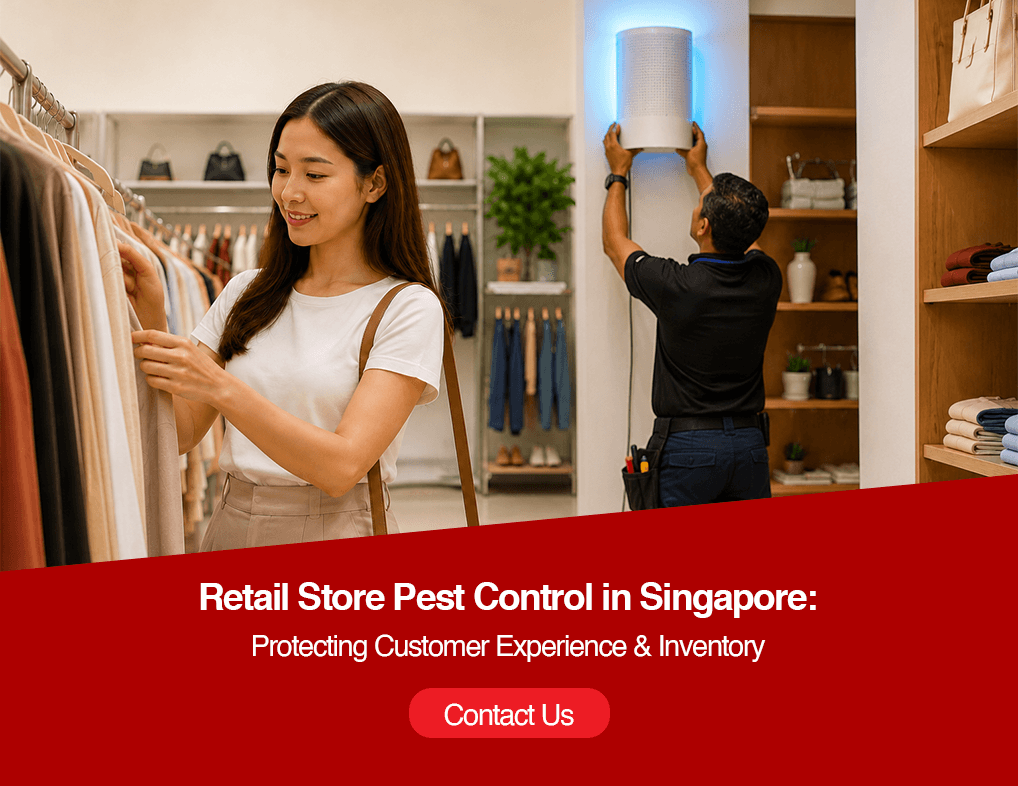
Retail stores in Singapore face a silent threat that most owners only notice after the damage is done; pests. Whether it is rodents gnawing through stock in a back storeroom, cockroaches spotted near a checkout counter, or flies hovering over a food retail display, any pest sighting can cost a store its reputation in seconds. Retail pest control in Singapore is not a once-a-year checkbox. It is an ongoing commitment to protecting customer experience, product integrity, and brand trust.
Singapore’s humid climate, dense commercial districts, and high-footfall environments make retail spaces particularly attractive to common pests. Regulatory requirements from the National Environment Agency add further pressure on business owners to maintain clean, compliant premises. The consequences of falling short are not just operational, they are financial and reputational. A single photograph shared on social media can travel faster than any pest ever could.
This guide breaks down the real pest risks facing retail stores in Singapore, what a professional pest management programme looks like in practice, and how proactive strategies not reactive panic keep your store protected year-round. Whether you manage a standalone boutique, a supermarket, or a chain of mall outlets, the principles are the same: know your risks, act before problems appear, and work with the right partner to stay ahead.
Why Retail Stores Are High-Risk Pest Environments
Retail stores are not just shops they are ecosystems of movement, warmth, food, and shelter that pests find extremely attractive. High customer footfall means doors open and close constantly, creating easy and frequent entry points for insects and rodents alike. Deliveries bring cardboard packaging and wooden pallets that are well-known harborage materials for cockroaches and rodents. Storage areas, often warm and cluttered, provide ideal nesting conditions that go undisturbed for long stretches between stock rotations. The combination of these factors creates an environment where pest pressure is not occasional it is structural.
Food retail outlets face compounded risk from organic waste, open product displays, and moisture from refrigeration units. But even non-food retailers are far from immune. Fabric stores attract moths and booklice, electronics retailers can harbour rodents that chew through cables and wiring, and beauty stores often see issues with flies and ants near organic product ranges. Understanding why retail spaces attract pests is the first step toward preventing them. Pest activity does not just damage inventory; a single customer sighting can trigger negative online reviews, regulatory inspections, and serious enforcement action, including fines, licence suspensions, or temporary closure orders in severe cases.
Common Entry Points and Harborage Zones
Pests enter retail stores through gaps around pipe penetrations, poorly sealed loading bay doors, drain openings, and air conditioning ducts. These are not dramatic breaches they are small, overlooked gaps that exist in almost every commercial building. Once inside, pests gravitate toward undisturbed storage areas, false ceilings, and the space beneath display shelving. These zones offer warmth, low foot traffic, and proximity to food or water sources, making them ideal for nesting and breeding without detection.
Cardboard boxes from supplier deliveries are a particularly common carrier of cockroach egg cases. A single delivery from an infested warehouse can introduce a population into your stockroom before anyone notices. Conducting a thorough entry point audit mapping every potential access route across the entire premises is a foundational step in any professional pest management programme. Sealing gaps, installing door sweeps on loading bay entrances, and maintaining clean, organised receiving areas significantly reduce pest ingress before a single treatment is applied. Prevention at the perimeter is always more cost-effective than remediation after establishment.
Harborage zones inside the store deserve equal attention. Cluttered stockrooms, infrequently moved display fixtures, and poorly maintained drainage channels all create conditions where pests can establish themselves undetected. A professional site inspection maps these zones systematically, assigning risk levels to each area based on pest biology and the specific conditions present. This structured approach ensures that monitoring and control resources are directed where they are most needed rather than spread thinly across the entire premises.
Seasonal Pest Pressure in Singapore’s Climate
Singapore’s year-round heat and humidity mean pest pressure never fully eases, but activity does spike at certain points. Mosquito populations increase during wetter months when standing water accumulates more readily in drains, plant pots, and outdoor areas. Rodent activity often intensifies in drier periods as rats and mice seek water sources indoors, making retail back-of-house areas and food storage zones particularly vulnerable. Cockroach breeding accelerates in warm, humid conditions which describes most Singapore retail back-of-house areas throughout the entire year.
Retailers who treat pest control as a seasonal concern miss the point entirely. A continuous monitoring approach, supported by data from tools like RATSENSE® IoT surveillance, provides real-time visibility into activity trends rather than relying on reactive inspections triggered by sightings. When you can see pest activity data in real time, you respond to what is actually happening not to what you happened to notice during a manual check. This shift from reactive to proactive is what separates stores that manage pest risk effectively from those that manage pest incidents after the fact.
The consistency of Singapore’s climate also means that there is no natural seasonal reset that reduces pest populations to manageable levels on its own. Unlike temperate climates where winter suppresses insect activity, Singapore’s conditions sustain breeding cycles year-round. This makes continuous monitoring and preventive maintenance not a premium option but a baseline requirement for any retail store that takes hygiene and customer experience seriously.
Regulatory Obligations for Retail Premises
The National Environment Agency holds retail businesses particularly food-related outlets to strict hygiene and pest management standards. Failure to maintain compliant premises can result in fines, public notices, or forced closures. These are not theoretical risks. NEA enforcement actions against food retailers are documented and public, and the reputational consequences of a public notice extend well beyond the immediate penalty. For any retail business operating in Singapore, regulatory compliance is not a background consideration it is a front-line operational requirement.
For food retailers operating under HACCP frameworks, compliance requires documented pest management protocols, trained staff awareness, and verifiable service records. This means working with a pest management provider that understands food safety requirements and can operate within them not just a general contractor who applies treatments without the documentation framework to support your compliance obligations. Working with an NEA-licensed pest management provider ensures your store meets these standards and has the paperwork to prove it when inspectors arrive.
Beyond food retail, all commercial premises in Singapore are expected to maintain basic hygiene standards that include pest prevention. Property managers overseeing retail units within larger developments carry additional obligations to ensure that pest activity in common areas does not spread to tenanted spaces. A pest management programme that covers the full premises including loading areas, bin centres, and drainage infrastructure is the only way to meet these obligations comprehensively and consistently.
The Real Cost of Pest Incidents in Retail
A pest incident in a retail store carries costs that go well beyond the immediate damage to stock. The reputational impact of a customer photograph shared on social media can reach thousands of people within hours. In Singapore’s highly connected consumer market, a single cockroach sighting posted online can significantly damage customer trust and negatively affect footfall and brand reputation. The speed at which negative perception spreads has no relationship to the size or severity of the actual incident; a solitary pest in an otherwise well-managed store can generate the same online response as a full infestation if it is captured and shared at the wrong moment.
Beyond reputation, there are direct financial losses from contaminated or damaged inventory, costs associated with emergency pest treatments, potential legal liability if a customer suffers harm, and the operational disruption of closing sections of a store for treatment. For food retailers, product recalls triggered by pest contamination carry regulatory reporting obligations on top of the financial write-off. Pest-related product losses, emergency remediation costs, and operational disruption can become financially significant for retail operators. The business case for proactive pest management is straightforward prevention costs a fraction of the damage control that follows an incident.
Inventory Damage and Product Loss
Rodents can destroy significant quantities of packaged goods in a single night. A rat’s front teeth never stop growing, which means they gnaw constantly through plastic packaging, cardboard, wooden shelving, and even electrical wiring. Contaminated stock cannot be sold and must be disposed of, creating direct financial loss that compounds quickly when rodent activity goes undetected for even a short period. For food retailers, the loss extends beyond the contaminated products themselves to include the cost of identifying the full scope of affected stock and the labour involved in disposal and restocking.
For fashion and textile retailers, moth larvae and booklice cause irreversible damage to fabric-based inventory that cannot be recovered through cleaning or treatment after the fact. A single moth infestation in a stockroom can render an entire season’s worth of garments unsellable. Implementing a Pest Risk Matrix approach which scores pests by probability of occurrence and potential damage severity helps retailers prioritise resources toward the threats most likely to impact their specific inventory type. A food retailer and a clothing boutique face different primary risks, and their pest management programme should reflect that difference rather than applying a generic solution across both.
The financial impact of inventory loss is also compounded by the timing of incidents. Pest damage discovered during peak trading periods ahead of a major sale event or during a high-footfall season creates operational pressure at precisely the moment when disruption is most costly. Continuous monitoring that detects activity early gives retail managers the opportunity to respond before damage escalates, preserving both stock and trading continuity.
Customer Experience and Brand Reputation
Customer trust is built over years and lost in moments. A pest sighting during a shopping visit creates an immediate association between that brand and poor hygiene regardless of how isolated the incident may be. For retail stores operating in competitive Singapore malls or high street locations, this perception damage directly affects footfall and repeat business. Customers who witness a pest incident rarely return quietly. They tell people in person and online and the resulting narrative is difficult to correct once it takes hold.
For hospitality-adjacent retailers such as food courts, supermarkets, and specialty food stores, the reputational risk is particularly acute. Customers in these environments have a heightened sensitivity to hygiene, and their expectations are correspondingly higher. A fly near a bakery display or a cockroach near a deli counter is not a minor inconvenience to the customer who sees it it is a reason to leave and not return. Proactive pest management is as much a customer experience investment as it is a hygiene requirement, and the stores that recognise this treat it with the same seriousness as staff training or store presentation.
Integrated Pest Management for Retail Environments
Integrated Pest Management is the professional standard for retail pest control in Singapore and for good reason. Rather than defaulting to blanket chemical treatments after a problem appears, IPM works through a structured four-stage process: systematic inspection, continuous monitoring, accurate pest identification, and targeted control using the least invasive methods available. For retail stores, this means fewer chemical applications, less disruption to trading hours, and a documented approach that satisfies regulatory requirements without requiring the store to close for extended treatment periods.
IPM also addresses root causes rather than symptoms. If cockroaches are repeatedly appearing near a drainage point, the solution is not just treatment it is identifying why that drain is attracting them and correcting the underlying condition. This might mean improving drainage maintenance, adjusting sanitation protocols, or sealing structural gaps that allow moisture to accumulate. This approach aligns with the operational reality of retail: you cannot shut your store for hours every time a pest is spotted. IPM keeps control continuous, targeted, and minimally disruptive, which is exactly what a trading retail environment requires. It also generates the documentation trail that regulatory inspections demand, giving store managers verifiable evidence of due diligence at every stage.
Inspection and Monitoring Protocols
A professional IPM programme begins with a detailed site inspection that maps pest activity, identifies entry points, and assesses risk across different zones of the store from customer-facing areas to stockrooms and loading bays. This initial assessment is not a quick walk-through. It is a structured evaluation that considers the specific pest risks associated with each zone, the structural conditions that may be contributing to those risks, and the operational factors such as delivery schedules and waste management practices that influence pest pressure over time.
Monitoring tools such as glue boards, bait stations, and IoT-enabled sensors like RATSENSE® provide ongoing data between service visits. This continuous visibility means pest activity is detected early, before it escalates into a visible infestation. For retail managers, regular monitoring reports also serve as documented evidence of due diligence during regulatory inspections demonstrating not just that treatments were applied, but that activity was tracked systematically and responded to appropriately. The shift from periodic inspection to continuous monitoring is one of the most significant improvements a retail store can make to its pest management programme.
Effective monitoring also allows pest management professionals to identify trends over time seasonal spikes, recurring activity in specific zones, or changes in pest species that may indicate new entry routes or harborage conditions. This trend data informs programme adjustments that keep control measures aligned with actual risk rather than following a fixed schedule regardless of what the data shows. For retail managers, this means a programme that becomes more precise and more cost-effective over time rather than one that applies the same interventions on a fixed calendar regardless of need.
Targeted, Chemical-Minimal Control Methods
When control action is required, IPM prioritises targeted interventions over broad chemical applications. In retail environments, this matters enormously chemical treatments near food displays, clothing stock, or customer areas carry real risks of contamination and exposure that no responsible retailer should accept. The goal is to apply the right treatment in the right place at the right time, not to saturate an environment with chemicals in the hope of catching every pest that might be present.
Alternatives include targeted gel baiting for cockroaches in defined harborage zones, strategic trapping for rodents, biological larvicides for mosquito breeding sites, and dry gas treatments where appropriate. ORIGIN’s chemical-free methodology means that treatments are applied precisely where pests are active, not across an entire store indiscriminately. This precision reduces the risk of chemical exposure for customers and staff, minimises the environmental footprint of the programme, and critically produces better results by targeting the actual locations where pests are present rather than treating the entire premises as a uniform risk zone.
For food retail environments where HACCP compliance governs what treatments can be used and where, this targeted approach is not just preferable it is essential. A pest management provider that understands food safety requirements will design a control programme that operates within those constraints without compromising effectiveness. The combination of targeted application, biological alternatives, and structural exclusion measures delivers results that broad chemical treatments cannot match, while keeping the store fully compliant with food safety and environmental standards.
Preventive Measures That Reduce Treatment Frequency
The most effective pest control for retail stores is the kind that reduces the need for reactive treatments altogether. Preventive measures include staff training on pest awareness and reporting, sanitation protocols for waste management and food spill response, structural maintenance to seal entry points, and supplier delivery checks to prevent pest introduction via incoming stock. When prevention is built into daily operations, the frequency and cost of treatment visits decreases and the risk of a customer-facing incident drops significantly.
Staff play a particularly important role in preventive pest management. A team that knows what early signs of pest activity look like droppings near shelving, gnaw marks on packaging, unusual odours in storage areas and knows how to report them promptly creates an early warning system that no technology can fully replace. When staff observations are combined with data from continuous monitoring systems, the pest management team has a complete picture of activity across the premises rather than relying solely on what sensors detect.
Sanitation and structural maintenance are equally important. Waste bins that are emptied regularly, drains that are kept clean and free-flowing, and delivery areas that are inspected before goods are moved into the store all reduce the conditions that attract and sustain pest populations. These measures cost relatively little to implement but have a disproportionate impact on pest pressure. A retail store that invests in prevention consistently spends less on reactive treatment over the course of a year than one that relies on periodic interventions after problems have already appeared.
Rodent Control Strategies for Retail Stores
Rodents are among the most damaging pests a retail store can face. Rats and mice contaminate stock, damage infrastructure, and pose serious health risks to both staff and customers. In Singapore’s dense commercial areas, rodent pressure from surrounding environments drains, back alleys, food waste collection points is constant. Retail stores do not exist in isolation; they are surrounded by conditions that sustain rodent populations, and those populations will exploit any opportunity to move indoors where food, warmth, and shelter are available.
Traditional rodent control using snap traps and bait stations has real limitations. Traps require frequent manual checks, and rodents that have encountered traps before often display avoidance behaviour, rendering conventional approaches less effective over time. A population that learns to avoid standard bait stations will continue to grow unchecked while giving the appearance of a managed situation. Data-driven rodent surveillance changes this entirely. RATSENSE®, ORIGIN’s IoT-based rodent monitoring system, provides 24/7 real-time detection of rodent activity without requiring staff to physically check every bait station. The system identifies active zones, potential access points, and harborage areas, allowing pest management professionals to deploy targeted interventions precisely where they are needed. For retail store managers, this means faster response times, less operational disruption, and a verifiable activity record that supports both internal compliance and external regulatory review.
RATSENSE® Smart Surveillance in Retail Settings
RATSENSE® uses IoT sensor technology to monitor rodent activity continuously across a retail premises. Sensors transmit real-time data on activity levels, trigger alerts when rodents are detected, and generate detailed reports that inform targeted control decisions. In retail environments where manual inspection of every bait station is impractical during trading hours and potentially disruptive to customer experience this remote monitoring capability is a significant operational advantage that changes how rodent management is delivered.
The system reduces manpower requirements by 50% while increasing capture effectiveness by 30% metrics that translate directly into cost efficiency and faster incident response for retail operators. Rather than scheduling routine visits on a fixed calendar, pest management professionals can respond to actual activity data, directing resources to the zones where rodents are present rather than checking locations where nothing is happening. This targeted deployment is more efficient, more effective, and less disruptive to store operations than traditional manual-check programmes.
For retail chains managing multiple locations, RATSENSE® also provides a standardised data framework across all sites, allowing property managers to compare activity levels, identify high-risk locations, and allocate resources accordingly. The accountability that comes from a documented, data-driven system is particularly valuable for organisations with compliance obligations whether to regulatory bodies, franchise standards, or internal governance requirements. When rodent activity is tracked in real time and every intervention is recorded, there are no gaps in the evidence trail.
Addressing Rodent Entry in Loading and Storage Areas
Loading bays and back-of-house storage areas are the most common rodent entry points in retail stores. Deliveries create regular opportunities for rodents to enter alongside goods, particularly in cardboard boxes and wooden pallets that may have been stored in infested warehouses before reaching the store. The rhythm of daily deliveries means these entry points are opened and closed repeatedly throughout the day, and even a brief window is sufficient for a rodent to move indoors if conditions are favourable.
Structural gaps around utility pipes, drainage channels, and poorly fitted roller doors compound the risk. These gaps are often small enough to be overlooked during routine inspections but large enough for a mouse which can pass through surprisingly small gaps. A targeted rodent management programme for retail focuses heavily on these zones, combining physical exclusion work, strategic bait station placement, and sensor-based monitoring to create a layered defence that addresses both entry prevention and active population control simultaneously.
The layered approach is important because no single method is sufficient on its own. Physical exclusion reduces ingress but cannot prevent all entry. Bait stations address active populations but may be avoided by trap-shy individuals. Sensor monitoring detects activity but does not itself reduce populations. When these methods are combined within a structured programme, each layer compensates for the limitations of the others, creating a defence that is more robust and more reliable than any single intervention could be. This is the practical application of IPM principles in one of the highest-risk zones of any retail store.
Mosquito and Flying Insect Management in Retail Spaces
Mosquitoes and flying insects are a particular concern for retail stores with outdoor seating areas, open-air shopfronts, food service zones, or proximity to landscaped areas. In Singapore’s warm and humid climate, mosquito activity can build quickly wherever stagnant water is allowed to collect. For retail businesses, this creates more than a comfort issue. It affects customer experience, hygiene standards, operational confidence, and brand reputation.
Retail environments also face heightened public sensitivity around flying insects. A mosquito problem around an alfresco dining area, or flies near exposed food displays and preparation surfaces, can quickly create the impression of poor hygiene even when the wider premises are well maintained. Furthermore, premises found with mosquito breeding habitats may face enforcement action from NEA, including fines. This is why flying insect management must address both visible adult insects and the conditions that allow populations to develop in the first place.
Beyond mosquitoes, flies pose a significant hygiene risk in food retail environments. A fly landing on exposed products or food preparation surfaces can transfer pathogens and trigger immediate customer complaints. The connection between flies and food contamination is well understood by consumers, which means even a single fly near a food display creates a hygiene concern that customers take seriously. An effective flying insect management programme therefore combines source reduction, sanitation, monitoring, and physical control methods to reduce both breeding conditions and adult insect activity.
For mosquitoes, ORIGIN’s 3+1 Mosquito Management Programme supports a more structured approach. The programme combines inspection, targeted misting, ORITrap monitoring, and ongoing activity review to help identify potential hotspots, assess changing mosquito pressure, and guide follow-up action where it is most needed. Rather than relying only on reactive treatment after mosquitoes become noticeable, the focus is on understanding where the pressure is coming from and managing it at the source.
Breeding Site Identification and Elimination
Mosquito management starts with finding where breeding is occurring, not just treating where adults are visible. Targeting adult mosquitoes without addressing breeding sites is the pest management equivalent of mopping the floor while the tap is still running: it may reduce the immediate problem, but it does not resolve the underlying cause.
In retail environments, potential mosquito breeding sites include blocked drains, water features, poorly maintained plant pots, and standing water around air-conditioning condensate outlets. These are not always obvious during day-to-day operations, which is why systematic inspection is an important first step.
A professional inspection maps potential breeding sites on and around the premises. Each area can then be assessed based on whether stagnant water is present, whether larvae are found, and whether site conditions are likely to support recurring mosquito activity. Where issues are identified, corrective action may include water removal, drainage improvement, housekeeping recommendations, larvicide application where appropriate, or targeted treatment of high-risk zones.
This source-reduction approach delivers more durable outcomes than adult treatment alone. By reducing breeding opportunities, retailers can lower mosquito pressure at its origin rather than simply suppressing adult mosquitoes temporarily. This is especially important in customer-facing environments, where treatment activity must be planned carefully to minimise disruption to customers, staff, products, and daily operations.
For retail stores with outdoor areas, whether a café terrace, an al fresco dining zone, or a landscaped entrance, breeding site management requires ongoing attention rather than a one-off treatment. Conditions can change after rainfall, drainage maintenance, and seasonal plant growth, meaning new breeding sites can develop between inspection visits. Incorporating breeding site checks into regular service visits, and training store staff to identify and report standing water between visits, creates the continuous vigilance that effective mosquito management requires.
ORITrap Technology for Retail Environments
The ORITrap is a key component of ORIGIN’s 3+1 Mosquito Management Programme, supporting mosquito management in outdoor and semi-outdoor retail environments. It is designed to use odour attractants to support mosquito trapping and monitoring, helping provide better visibility of mosquito activity in areas where breeding pressure may change over time.
For retail properties, this visibility matters. Mosquito activity is often noticed first in customer-facing areas, but the source may be hidden elsewhere, such as a drain, planter, water feature, service corridor, or landscaped perimeter. ORITrap monitoring adds another layer of information that can support inspection findings and help guide where follow-up action should be focused.
Made from recycled polypropylene, ORITrap also supports a more considered approach to pest management in customer-facing environments. For retail brands with sustainability commitments, the pest management programme they choose forms part of the wider operational story. A solution that supports monitoring, helps avoid an over-reliance on blanket treatments, and allows interventions to be directed more precisely can contribute to both hygiene standards and responsible site management.
In outdoor retail areas and food court perimeters, ORITrap can be used as part of a broader mosquito management programme alongside inspection, source reduction, targeted misting, and advisory. The value is not simply in placing traps, but in using information gathered from site activity to understand where mosquito pressure may be building and how management actions should be adjusted.
Together, ORITrap and ORIGIN’s 3+1 Mosquito Management Programme help shift mosquito control from a reactive service into a more structured and data-informed approach. The goal is to better understand where mosquito pressure is coming from, how site conditions are changing, and where intervention should be focused next.
Frequently Asked Questions
Q: How often should a retail store in Singapore schedule professional pest control visits?
A: Retail stores in Singapore should maintain continuous pest monitoring year-round rather than relying on periodic visits, given the country’s humidity sustains breeding cycles without seasonal breaks. A programme combining regular service visits with IoT-based tools like RATSENSE® provides real-time data between inspections so issues are caught before customers ever notice them.
Q: Can a single pest sighting in my shop really damage my brand reputation that seriously?
A: Yes in Singapore’s highly connected consumer market, one photograph of a cockroach or rodent shared on social media can reach thousands of people within hours and directly affect footfall and repeat business. The speed of reputational damage has no relationship to the actual severity of the incident, which is why prevention matters far more than damage control.
Q: What pest risks do non-food retailers like clothing or electronics stores actually face?
A: Fabric and fashion stores are vulnerable to moth larvae and booklice that cause irreversible damage to garments, while electronics retailers face rodents that gnaw through cables and wiring. A Pest Risk Matrix approach helps non-food retailers identify which threats are most relevant to their specific inventory rather than applying a one-size-fits-all treatment programme.
Q: What makes ORIGIN’s approach to retail pest control different from a standard exterminator?
A: ORIGIN uses an Integrated Pest Management methodology that targets root causes rather than just visible symptoms, combining chemical-minimal treatments, structural exclusion, and technology like RATSENSE® smart surveillance and the 3+1 Mosquito Management Programme. This delivers documented, data-driven results that satisfy NEA regulatory requirements while minimising disruption to trading hours and reducing chemical exposure near customers and stock.
Q: What are the NEA compliance requirements retail stores in Singapore must meet for pest management?
A: Commercial premises in Singapore are expected to maintain sanitary conditions and take reasonable measures to prevent pest infestations. Food retailers operating under HACCP or other food safety management systems may also be required to maintain documented pest management protocols and verifiable service records during audits or inspections. Working with an NEA-licensed pest management provider can help support compliance by providing structured treatment programmes, monitoring, and documented service records.
Q: How do pests typically enter a retail store even when it looks clean and well-maintained?
A: Pests most commonly enter through gaps around pipe penetrations, poorly sealed loading bay doors, and drain openings, small structural oversights that exist in almost every commercial building. Supplier deliveries are another major introduction route, as cardboard boxes from infested warehouses can carry cockroach egg cases directly into your stockroom before a single pest is ever spotted.
Q: Is it worth investing in smart rodent monitoring technology for a small retail outlet, or is it only for large chains?
A: Even a single rodent incident in a small retail store can trigger the same reputational and financial consequences as one in a large chain, making early detection equally valuable regardless of store size. RATSENSE® reduces manpower requirements by 50% while increasing capture effectiveness by 30%, meaning smaller operators often see a faster return on investment by avoiding the far greater cost of a reactive incident response.

