
Pest Control for Data Centres in Singapore
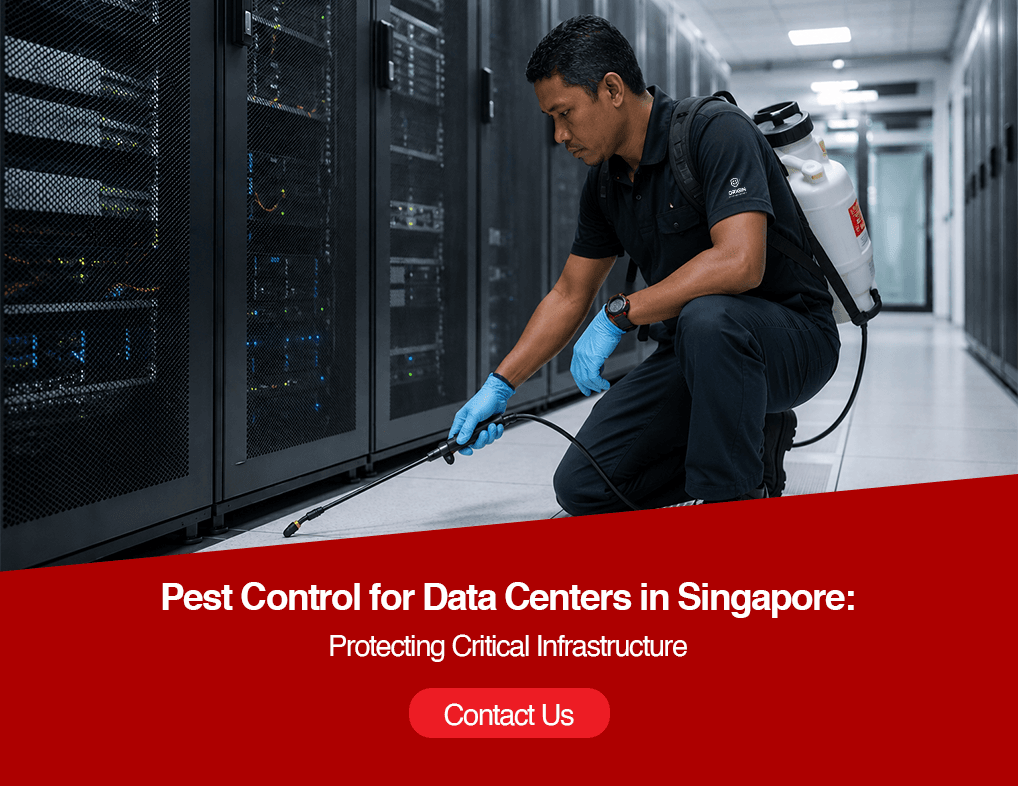
Data centres are the backbone of Singapore’s digital economy. They run around the clock, housing servers, cooling systems, and critical infrastructure that simply cannot afford unplanned downtime. Security teams guard against cyber threats. Engineers monitor hardware performance. But one risk sits entirely outside the IT department and is routinely underestimated: pests. Rodents gnaw through power cables. Cockroaches find their way inside electrical panels. Certain ant species have been observed aggregating around electrical equipment and can trigger short circuits in sensitive components. The damage is real, well-documented, and entirely preventable.
Pest control for data centres in Singapore demands a different standard from what works in an office block or warehouse. The environment is sensitive, the stakes are high, and conventional chemical treatments introduce their own risks to delicate hardware. What these facilities need is continuous monitoring, chemical-free intervention methods, and a structured programme built on science rather than routine calendar sprays. This article covers the specific pest risks facing data centre facilities in Singapore, the control strategies that are actually suited to these environments, and why a proactive, evidence-based approach is the only sensible way to protect infrastructure worth millions.
Why Data Centres Face Unique Pest Risks
Data centres are not typical commercial buildings, and they should not be managed like one. They operate continuously, maintain tightly controlled temperatures, and house dense concentrations of electrical equipment. These same conditions that make them ideal for digital infrastructure also make them inadvertently attractive to pests. Warm server rooms replicate the sheltered, heat-rich environments that rodents and insects actively seek out. Cable management voids, raised flooring systems, and dense wiring create harborage zones that can go completely unchecked for months at a time, particularly in areas with restricted human access.
Singapore’s tropical climate compounds the challenge significantly. Unlike facilities in temperate countries that experience natural seasonal reductions in pest pressure, Singapore’s year-round heat and humidity sustain pest populations continuously. Cockroach and ant activity does not slow during cooler months because there are none. Monsoon seasons drive rodents indoors in search of dry shelter, and data centres, with their consistent warmth and relatively low foot traffic in certain zones, are precisely the kind of environment they target. Unlike an office or warehouse where pest activity is an inconvenience, pest activity inside a data centre carries consequences measured in service outages, hardware replacement costs, and potential breaches of client service level agreements. The stakes are categorically higher, and the pest management strategy must reflect that reality.
Electrical Infrastructure as a Pest Target
Rodents are drawn to cable insulation not out of random curiosity but because of a biological drive. Their incisors grow continuously throughout their lives, and gnawing is how they manage that growth. Inside a data centre, this means power cables, fibre optic lines, ethernet connections, and cooling system tubing are all legitimate targets. Norway rats, which are common across Singapore’s urban areas, are capable of breaching building perimeters through gaps as small as 20 millimetres. Roof rats navigate vertical spaces with ease, accessing ceiling voids directly above server halls. Once inside, they move along cable trays and through raised flooring systems, often without any visible indication until damage has already occurred.
Cockroaches and ants present a different but equally serious electrical hazard. Their bodies conduct electricity, and when they access live components inside power distribution units, UPS battery housings, or server panel enclosures, the results can range from minor component damage to full rack failures. Accumulated debris and organic contamination from cockroach activity may affect sensitive equipment if infestations are left unmanaged. Fire suppression systems and battery rooms are particularly vulnerable given the warmth they generate and the relative infrequency with which they are physically inspected. Facilities with raised flooring face additional exposure, as the undisturbed space beneath creates a natural pest corridor running the full length of the server hall.
Singapore’s Climate and Pest Pressure
Singapore’s position just north of the equator means pest pressure is not a seasonal problem it is a constant one. Cockroach populations breed faster in warm, humid conditions, and Singapore’s ambient environment is effectively optimal for several species. German cockroaches, in particular, thrive in the microclimate created by electrical equipment, where warmth is concentrated and disturbance is infrequent. A single undetected population can expand rapidly in these conditions, moving between zones through cable penetrations and sub-floor voids before facilities teams are aware of any activity.
Ant colonies establish themselves quickly when moisture or food sources are available, and data centre environments often provide both in unexpected ways. Cooling infrastructure produces condensation. Canteen and break areas adjacent to server halls introduce food debris. Urban construction activity across Singapore regularly displaces established rodent populations, pushing them toward nearby buildings in search of alternative harborage. Data centres, with their consistent internal temperatures and low foot traffic in back-of-house areas, are attractive destinations. Facilities management teams often concentrate pest control efforts on visible common areas, leaving server halls and sub-floor spaces under-monitored. That gap is precisely where infestations take hold.
Low-Traffic Zones and Blind Spots
Some of the most pest-vulnerable areas in a data centre are also the least frequently visited. Cable ducts, sub-floor voids, rooftop cooling units, and back-of-house service corridors may go weeks or months without any human presence. These are not peripheral spaces in pest terms, they are prime real estate. Pests establish themselves in undisturbed environments, and the combination of warmth, shelter, and minimal human activity makes these zones highly attractive. By the time a technician notices droppings near a server rack or spots a rodent during a routine maintenance visit, the infestation may already be well established and actively causing damage.
Traditional reactive pest control, which responds only when activity is visibly detected, is structurally unsuitable for data centre environments. The model assumes that pest activity will be noticed before it becomes a problem. In a facility where entire zones can go uninspected for extended periods, that assumption does not hold. Continuous monitoring across all facility zones, including those with restricted access, is what separates genuinely protective pest management from a programme that merely creates the appearance of oversight. In a data centre context, the difference between those two things can be the difference between operational continuity and a significant infrastructure failure.
Pest Species That Pose the Greatest Threat
Not all pests carry equal risk inside a data centre, and treating them as though they do leads to misallocated resources and inadequate protection where it matters most. Understanding which species are most likely to cause infrastructure damage, and how they behave in data centre environments specifically, allows facilities teams to prioritise monitoring and control efforts effectively. Singapore’s urban pest landscape includes several species that are particularly problematic in these settings, each presenting distinct risks to different components of the facility.
A structured approach to pest risk assessment, one that categorises species by both the likelihood of their presence and the severity of the damage they can cause, gives data centre operators a rational basis for resource allocation. This is the logic underpinning a Pest Risk Matrix: rather than applying equal attention to every possible pest, it directs the most intensive monitoring and control resources toward the species that combine high probability with high consequence. In a data centre, rodents, cockroaches, and ants consistently rank at the top of that matrix, and each requires a distinct management approach.
Rodents and Cable Damage
Rats and mice represent the primary structural threat in data centre environments. Their gnawing behaviour is not opportunistic; it is biologically constant and entirely indiscriminate when it comes to cable materials. Power cables, ethernet lines, fibre optic connections, and cooling system tubing are all at risk. Norway rats are strong enough to breach building perimeters through surprisingly small gaps, while roof rats are agile climbers that access ceiling voids and overhead cable management systems with ease. Once inside, both species move along the same routes that cables follow, making the infrastructure itself a guide path for pest movement through the facility.
The consequences of rodent-caused cable damage in a data centre are not limited to the immediate point of failure. A breach in a single power distribution unit can cascade into server rack failures across an entire row. Fibre optic damage can disrupt connectivity across multiple systems simultaneously. The cost of hardware replacement is compounded by the operational impact of unplanned downtime and the reputational risk of SLA breaches. Early detection through IoT-based rodent surveillance, such as ORIGIN’s RATSENSE® system, allows facilities teams to identify activity before physical damage occurs, rather than discovering a rodent problem during a fault investigation when the damage is already done.
Cockroaches in Electrical Panels
German cockroaches are strongly and consistently attracted to the warmth generated by electrical equipment. They have been found inside power distribution units, behind server panels, within UPS battery housings, and inside the enclosures of network switching equipment. Their bodies conduct electricity, making their presence inside live electrical components a direct short-circuit risk. Over time, their faecal deposits accumulate on contact surfaces and circuit boards, creating corrosive residue that degrades component performance and longevity. In environments where equipment uptime is measured in nines, this is not a minor hygiene concern; it is an operational risk with quantifiable consequences.
What makes cockroaches particularly challenging in data centre environments is their reproductive rate and their preference for concealed, undisturbed spaces. A single female German cockroach can produce hundreds of offspring within a year. In a warm, low-traffic environment like a sub-floor void or the interior of an electrical enclosure, a small and initially undetected population can become a significant infestation within weeks. Standard reactive inspection schedules are poorly matched to this rate of population growth. By the time activity is visible, the infestation is typically already well established across multiple zones.
Ants and Electrical Component Failures
Ants are frequently dismissed as a minor nuisance compared to rodents or cockroaches, but that assessment does not hold in data centre environments. Fire ants and crazy ants in particular have a documented and well-studied attraction to electrical fields. Globally, ant-related electrical failures have caused significant equipment damage in data centres, telecommunications facilities, and industrial plants. In Singapore, multiple ant species are active year-round, and their small size allows them to access sealed enclosures through gaps that are effectively invisible to the naked eye. Once inside, they can trigger short circuits, damage sensitive circuit boards, and deposit debris that interferes with component cooling.
Ant colonies also respond to disturbance by relocating rapidly, which creates a specific problem with conventional treatment approaches. Aerosol sprays and surface treatments applied near ant activity often scatter the colony rather than eliminate it, spreading the problem across a wider area of the facility. Targeted baiting programmes that address the colony at its source, delivering a slow-acting treatment that worker ants carry back to the queen, are significantly more effective and far more appropriate for the data centre environment. This approach eliminates the colony rather than displacing it, and it does so without introducing chemical agents near sensitive equipment.
Chemical-Free Pest Control in Sensitive Environments
Standard pest control methods are not appropriate for data centre environments, and the reasons go beyond preference. Aerosol sprays and liquid chemical treatments carry genuine technical risks in these settings. Improperly applied chemical treatments may leave residues that are unsuitable for sensitive electronic environments. Certain formulations are corrosive to metal components found in server racks and electrical enclosures. Some treatments may void equipment warranties if applied in proximity to specific hardware. For facilities housing millions of dollars of infrastructure, the treatment methodology cannot introduce new risks while addressing existing ones. The approach must be effective and safe for the environment it operates in simultaneously.
Chemical-free pest management built on physical exclusion, targeted baiting, IoT monitoring technology, and biological controls delivers effective results without exposing equipment to chemical agents. This is not simply a preference for environmentally conscious operators; in many data centre contexts, it is a technical requirement driven by equipment sensitivity, warranty conditions, and client contractual obligations. ORIGIN’s approach to pest management in critical infrastructure prioritises non-chemical interventions as the primary control method, with any necessary treatments applied in targeted, contained formats that do not affect surrounding equipment. The goal is effective pest control that the facility’s hardware never needs to know about.
Physical Exclusion as the First Line of Defence
Preventing pests from entering the facility in the first place eliminates the need for reactive treatment and is the most structurally sound investment a data centre can make in pest management. A thorough inspection maps all potential entry points: cable penetrations through external walls, ventilation gaps, loading dock door seals, drainage lines, and perimeter wall junctions. Each of these represents a pathway that pests can and will use if it remains open. Sealing these access points with appropriate materials, matched to the specific gap type and the pest species being excluded, removes the routes through which infestations establish themselves.
In data centre environments, exclusion work must be carefully coordinated with facilities management teams to avoid disrupting cable routing, airflow management, or access control systems. This requires a pest control provider who understands the operational context of the facility, not simply one who applies generic exclusion techniques. Done correctly and maintained over time, physical exclusion is the most cost-effective long-term pest control investment available. It addresses the root cause of pest presence rather than managing the consequences of it, which is precisely the orientation that critical infrastructure facilities require.
Targeted Baiting Systems for Rodent Control
Where rodent activity is identified, tamper-resistant bait stations positioned along perimeter walls, within sub-floor voids, and at identified activity points provide controlled, contained treatment. Unlike broadcast spraying or generalised chemical application, targeted bait stations confine the active agent to a specific, defined location. This eliminates the risk of chemical drift, residue contamination near equipment, or incidental exposure to personnel working in adjacent areas. Bait formulations are selected based on the rodent species identified, observed activity patterns, and the specific layout of the facility, ensuring the treatment is matched to the actual problem rather than applied as a default response.
Regular inspection and replenishment of bait stations, combined with activity data from continuous monitoring systems, ensures the programme remains genuinely responsive to actual pest pressure. A well-managed baiting programme does not follow a fixed calendar schedule regardless of conditions; it adjusts based on what the data shows. When monitoring indicates elevated rodent activity in a specific zone, bait station density in that area increases. When activity decreases, the programme scales back accordingly. This adaptive approach is more resource-efficient and more effective than static programmes applied uniformly across the facility at fixed intervals.
Continuous Monitoring with IoT Surveillance Technology
In a data centre, manual pest inspections conducted fortnightly or monthly are not sufficient to provide meaningful protection. Pest activity does not follow a schedule, and the consequences of a missed infestation are too significant to accept detection gaps measured in days or weeks. A rodent that accesses a sub-floor void on a Tuesday and begins gnawing through cable insulation will not wait for the next scheduled inspection before causing damage. The inspection model that works adequately in lower-stakes commercial environments is structurally mismatched to the risk profile of critical infrastructure.
Continuous, real-time monitoring transforms pest management from a periodic service into an always-on system that generates data, triggers alerts, and enables rapid response. RATSENSE®, ORIGIN’s IoT-based rodent surveillance solution, provides 24/7 monitoring across all deployed sensor points throughout the facility. The system identifies rodent presence, activity levels, and movement patterns without requiring physical checks at every location, reducing the need for routine manual inspections by up to 80%. For data centre facilities managers, this translates directly into fewer access requests, less operational disruption, and a continuously maintained audit trail of pest activity and response actions that supports both internal reporting and external compliance requirements.
How RATSENSE® Works in Data Centre Deployments
RATSENSE® sensors are placed at strategic points throughout the facility, covering sub-floor voids, cable management corridors, perimeter zones, loading dock areas, and back-of-house spaces. Each sensor transmits real-time activity data, flagging rodent presence immediately rather than waiting for a scheduled inspection to surface the information. When activity is detected, ORIGIN’s team receives an alert and can deploy a targeted response within hours. This speed of detection and response is what prevents isolated rodent activity from developing into an established infestation with associated infrastructure damage.
Beyond immediate alerts, the system generates trend data over time that identifies patterns in rodent movement and highlights specific access points or harborage zones that require structural attention. If sensors in a particular corridor consistently show elevated activity following rainfall events, that pattern points toward a specific entry point that is being used more frequently during monsoon conditions. This kind of insight moves pest management from reactive to genuinely predictive, addressing the conditions that drive pest activity before they result in infestations. For data centre operators, having this level of visibility across the full facility at all times represents a meaningful upgrade from conventional inspection-based programmes.
Audit Trails and Compliance Documentation
Data centres operate under strict compliance frameworks, and pest control documentation forms a legitimate part of this picture. Facilities undergoing audits or client inspections need to demonstrate that pest risk is actively managed, monitored, and responded to in a documented and verifiable way. RATSENSE® generates detailed activity reports that provide precisely this: verifiable records of monitoring coverage, sensor activity, response times, and treatment actions taken. These reports can be produced on demand and are formatted to support facilities management reporting requirements rather than existing purely as internal pest control records.
For operations teams managing compliance across multiple dimensions simultaneously, having pest management documentation that integrates cleanly into existing reporting structures is a practical operational benefit. It removes the need to manually compile evidence of pest management activity for audits and gives internal stakeholders clear, real-time visibility of pest risk status across the facility. The combination of continuous monitoring and structured reporting means that pest management is no longer an area of operational uncertainty; it becomes a documented, managed, and demonstrably controlled risk.
Reducing Operational Disruption Through Remote Monitoring
Every physical access to a live data centre floor carries inherent operational risk. Accidental cable disconnection, electrostatic discharge, and the general disruption of personnel moving through active server environments are all genuine concerns that facilities teams manage carefully through access control protocols and change management processes. Reducing the frequency of physical pest inspection visits through remote monitoring directly reduces this category of risk. When the monitoring system is doing the continuous surveillance work, the physical presence of pest control technicians on the data centre floor is limited to targeted response visits rather than routine check-ins.
RATSENSE® accounts for approximately 80% of monitoring activity remotely, meaning the vast majority of pest surveillance occurs without any physical access to the facility floor. This is a meaningful operational benefit that goes beyond pest management efficiency. Fewer access events mean fewer opportunities for incidental disruption, fewer entries in the change management log, and less coordination overhead for facilities teams already managing complex operational schedules. For data centre operators where access control is a serious operational discipline, a pest management programme built around remote monitoring is not just technically preferable; it is operationally aligned with how the facility is actually run.
Integrated Pest Management for Data Centre Facilities
A single treatment or one-off inspection is not a pest management strategy. It is a temporary response to a visible symptom, and in a data centre environment, it leaves the underlying conditions that attract and sustain pests entirely unaddressed. Data centres require a structured, ongoing programme that addresses pest risk systematically across the full facility and adapts over time as conditions change. Integrated Pest Management provides this framework. Rather than defaulting to chemical treatment at the first sign of activity, IPM investigates root causes: why pests are present, where they are entering, and what conditions within or around the facility are supporting them.
The Pest Risk Matrix complements IPM by providing a systematic scoring tool that categorises pest species against two dimensions: the probability of their presence in the specific facility environment, and the severity of the damage they are capable of causing. This grid-format assessment gives data centre operators a structured, evidence-based basis for resource allocation. Rodents, with their high probability of presence in Singapore’s urban environment and their capacity for significant infrastructure damage, rank at the top of the matrix and receive the most intensive monitoring and control resources. Together, IPM and the Pest Risk Matrix give facilities teams a pest management approach that is proportionate, documented, and genuinely defensible to auditors, clients, and senior management alike.
Systematic Inspection and Risk Scoring
The foundation of any effective IPM programme for a data centre is a thorough baseline inspection that covers all facility zones, including areas with restricted access. This is not a surface-level walk-through; it is a structured assessment that maps current pest activity, identifies structural vulnerabilities such as unsealed cable penetrations and drainage gaps, and establishes a risk score for each relevant pest species using the Pest Risk Matrix. The output of this inspection is a clear picture of where the facility stands in terms of pest risk and a prioritised action plan that directs resources toward the most significant threats first.
High-probability, high-damage species such as rodents receive the most intensive monitoring and control resources from the outset. Lower-risk species are monitored but managed with proportionately lighter interventions. This tiered approach prevents over-treatment and unnecessary expenditure while ensuring that the threats most capable of causing operational disruption receive appropriate attention. The risk scoring is not static; it is updated as monitoring data accumulates and as conditions within and around the facility change, ensuring the programme remains calibrated to actual risk rather than historical assumptions.
Preventive Measures Tailored to Facility Layout
Preventive pest management in a data centre addresses the conditions that make pest establishment possible, not just the pests themselves. This requires a detailed understanding of the specific facility layout and the operational activities that take place within and around it. Waste management practices in canteen and break areas adjacent to server halls, for example, can directly influence pest pressure in the server environment if not properly managed. Drainage and moisture management in cooling infrastructure zones create conditions that attract cockroaches and ants if not addressed. Landscaping or vegetation near building perimeters can harbour rodent populations that then seek indoor access as urban development displaces their existing territories.
Preventive recommendations developed through IPM are specific to the facility in question, not generic checklists applied uniformly across all sites. The goal is to reduce pest pressure at source by making the facility structurally and operationally less attractive to pests over the long term. This is a fundamentally different orientation from reactive pest control, which accepts pest presence as inevitable and focuses purely on elimination. Preventive IPM treats pest establishment as the outcome to be avoided, investing in the conditions that make infestation less likely rather than managing the consequences after it has occurred.
Ongoing Monitoring and Programme Adjustment
IPM is not a set-and-forget programme, and in a data centre context, treating it as one would undermine its effectiveness. Pest pressure changes with Singapore’s monsoon seasons, with construction activity in surrounding urban areas, and with operational changes within the facility itself. A new loading dock configuration, a change in waste management practices, or the addition of a new server hall all alter the pest risk profile of the facility and should prompt a review of the monitoring and control strategy in place. A well-managed IPM programme includes scheduled review points where monitoring data is assessed, risk scores are updated, and control strategies are adjusted accordingly.
For data centres, this adaptive approach means the pest management programme scales up monitoring during higher-risk periods, such as the monsoon season when rodent displacement is more common, and maintains baseline coverage during lower-activity periods. It also means that changes in the facility’s operational footprint are reflected in the pest management programme rather than leaving newly added areas unmonitored. This continuous calibration delivers more consistent and reliable protection than fixed-schedule programmes that apply the same treatment regardless of what the actual conditions on the ground are showing.
Selecting a Pest Control Partner for Critical Infrastructure
Not every pest control provider is equipped to work in a data centre environment, and the selection decision carries real consequences. The combination of access control requirements, chemical sensitivity, compliance documentation needs, and the operational consequences of service failure demands a provider with specific capabilities and a demonstrable track record in critical or sensitive facilities. A provider that approaches a data centre the way it approaches a restaurant or office block is not the right fit, regardless of how competent it may be in those contexts. The environment is different, the constraints are different, and the standards required are higher.
Key criteria for provider selection include proven experience with chemical-free and low-chemical methodologies, the ability to deploy and manage IoT-based monitoring systems, familiarity with data centre access and change management protocols, and the capacity to generate compliance-ready documentation that integrates with the facility’s existing reporting requirements. Certifications are relevant here not as a box-ticking exercise but as verifiable evidence that the provider operates to documented standards across environmental management, occupational safety, and regulatory compliance. In a high-stakes environment, those credentials are a meaningful indicator of a provider capable of operating professionally and reliably over the long term.
Certifications That Matter in High-Stakes Environments
A pest control provider working in a data centre should demonstrate structured compliance across environmental and occupational safety management systems.
ISO 14001 certification indicates that the provider operates an environmental management system aligned with internationally recognised standards, including controls for chemical usage, waste handling, and environmental impact reduction.
ISO 45001 certification demonstrates that the provider has implemented an occupational health and safety management system that requires documented procedures, risk assessments, and safety controls for technicians working in high-risk environments such as live data centres.
Frequently Asked Questions
Can pest activity actually cause data centre downtime, or is this mostly a theoretical risk?
A: It is a well-documented operational risk: rodents gnawing through power cables and ants triggering short circuits in electrical panels have caused real infrastructure failures and unplanned outages in live facilities. The damage is physical, measurable, and often discovered only after it has already disrupted services.
Q: Why can’t a data centre just use standard commercial pest control treatments?
A: Aerosol sprays and liquid chemical treatments can leave corrosive residue on circuit boards, contaminate sensitive hardware, and in some cases void equipment warranties making them technically unsuitable for environments housing millions of dollars of infrastructure. Chemical-free methods such as physical exclusion, targeted baiting, and IoT monitoring are the appropriate standard for these facilities.
Q: How does ORIGIN’s RATSENSE® system reduce disruption to live data centre operations?
A: RATSENSE® enables a significant portion of monitoring activity to be conducted remotely through continuously active IoT sensors, meaning most monitoring occurs without any technician physically accessing the data centre floor. This significantly reduces the number of access events, change management entries, and coordination overhead for facilities teams.
Q: What makes Singapore’s climate a bigger pest risk for data centres compared to other countries?
A: Unlike facilities in temperate regions that see seasonal drops in pest activity, Singapore’s year-round heat and humidity keep cockroach and ant populations breeding continuously, while monsoon seasons actively displace urban rodent populations toward indoor harborage like data centres. There is no low-risk season to rely on.
Q: Which pests cause the most serious damage inside a data centre, and why are ants often underestimated?
A: Rodents rank highest due to their constant gnawing behaviour, but certain ant species, including crazy ants, are known to infest electrical equipment and can contribute to short circuits and component failures. Standard aerosol treatments often scatter ant colonies rather than eliminate them, spreading the problem further across the facility.
Q: How does a Pest Risk Matrix help data centre facilities managers allocate their pest control budget more effectively?
A: It scores each pest species against both the probability of their presence and the severity of damage they can cause, so the most intensive monitoring and control resources are directed at high-consequence threats like rodents rather than spread uniformly across every possible pest. This prevents over-treatment in low-risk areas while ensuring critical infrastructure zones receive proportionate protection.
Q: What pest control documentation should a data centre be able to produce during a compliance audit?
A: Audits in regulated or high-risk environments typically require more than basic service attendance logs. They generally expect verifiable records of pest monitoring coverage, detected activity, corrective actions, response timelines, and treatment measures.
Integrated pest management frameworks emphasise documentation of inspections, monitoring data, and follow-up actions as part of demonstrating ongoing control and verification.
Continuous IoT monitoring systems can generate structured digital records that support audit and compliance reporting by providing time-stamped activity logs, trend data, and documented response actions across the facility.

