
Pest Control Compliance Audit Failures in Singapore
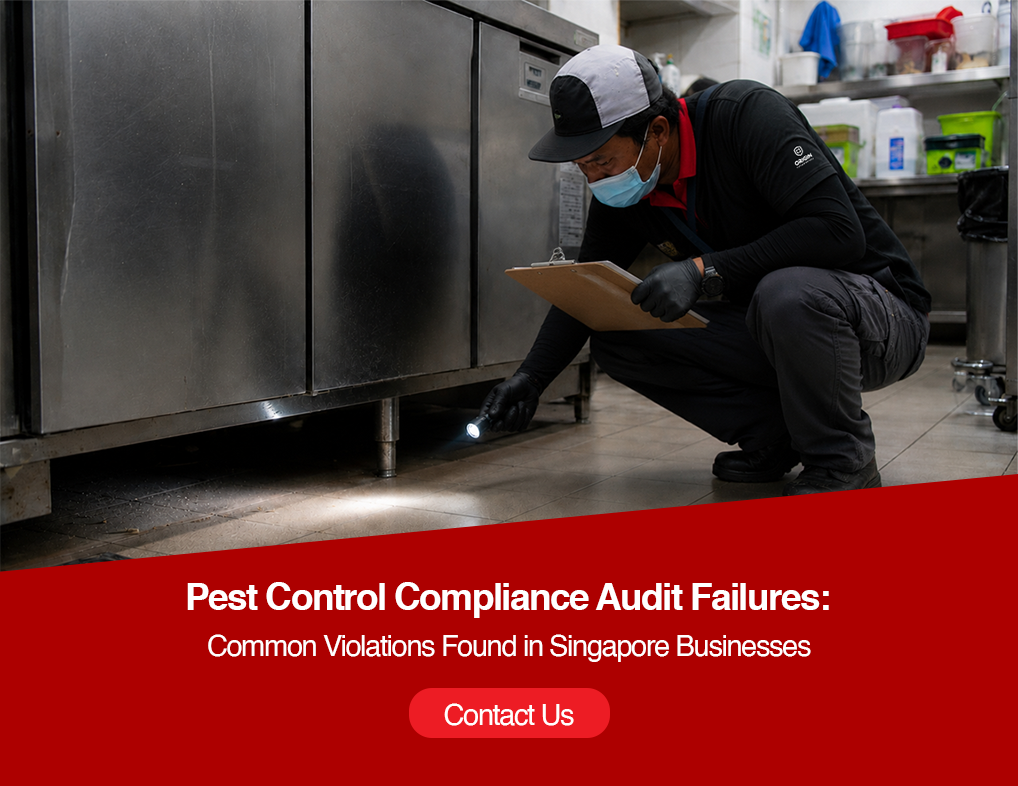
Pest control compliance audit failures are more common across Singapore businesses than most operators would care to admit. From food manufacturing facilities to hotel kitchens and commercial warehouses, a single audit may expose violations that lead to regulatory action, failed audits, and reputational risk depending on severity. Yet many of these failures are entirely preventable, rooted not in complex regulatory grey areas but in straightforward gaps that go unaddressed until an auditor walks through the door.
This article breaks down the most frequently cited violations found during pest control compliance audits across Singapore’s commercial sectors, and what businesses can do to avoid them. Whether you manage a food processing plant, a hospitality venue, or a multi-unit commercial property, understanding where audits go wrong is the first step toward getting them right. ORIGIN Exterminators, with over 35 years of pest management experience and the distinction of being the world’s first ISO 14001-certified pest management company, has observed these patterns repeatedly across Singapore’s commercial landscape. The findings here are grounded in operational experience, regulatory frameworks, and the real-world consequences businesses face when pest control programmes fall short of compliance standards.
Inadequate Pest Monitoring Documentation
One of the most consistently cited audit failures across Singapore businesses is the absence of proper pest monitoring records. Regulators (such as NEA/SFA) and third-party auditors (such as HACCP, ISO, or GMP certification bodies) typically expect to see consistent, dated documentation showing pest activity levels, inspection intervals, and corrective actions taken. Many businesses rely on verbal updates from their pest control vendor or maintain incomplete logbooks neither of which satisfies audit requirements. Documentation is not a bureaucratic formality; it is the evidence that a pest management programme is functioning as intended.
A well-structured pest monitoring programme generates a clear paper trail: trap inspection records, rodent activity logs, mosquito larvae count data, and technician visit reports. Without these, even a genuinely effective pest management programme appears non-compliant on paper. Businesses operating in food-sensitive environments are particularly exposed, as HACCP audits scrutinise documentation as rigorously as physical site conditions. In audit terms, gaps in records are treated as gaps in control and inspectors have no obligation to assume otherwise.
Missing Technician Visit Logs
Regulators and certification auditors commonly review signed service reports for every pest control visit carried out on a premises. Missing or unsigned technician logs are a straightforward violation, and one that signals poor vendor accountability rather than any complex operational failure. The fix is equally straightforward: businesses should request detailed visit reports after every service call, confirming which zones were inspected, what pest activity was recorded, and what treatments were applied or recommended.
Digital reporting systems make this far easier to maintain consistently. IoT-based platforms, such as those integrated into ORIGIN’s RATSENSE® rodent surveillance solution, generate automatic activity logs and real-time reports that remove the risk of missing or incomplete manual records. For businesses managing multiple sites or high-footfall environments, this kind of automated documentation provides an audit-ready record without relying on manual entry after every visit. The technology handles the paper trail; your team simply needs to ensure it is being used.
For businesses not yet using digital platforms, the minimum standard is a physical logbook maintained on-site, signed by the attending technician, and reviewed by a designated compliance contact within the business. Unsigned or undated entries carry no evidential weight during an audit and are routinely flagged as violations regardless of how thorough the actual service may have been.
Absence of Trend Analysis Records
Many HACCP and mature IPM-based programmes increasingly include trend monitoring not just snapshots of individual visits, but patterns of pest activity tracked over time. A single inspection report tells an auditor very little about the effectiveness of a pest management programme. A three-month trend showing declining rodent activity, mapped against corrective measures taken, tells a story of active, responsive management. That distinction matters significantly under modern food safety and hygiene standards.
Businesses without trend data struggle to demonstrate that their pest control programme is proactive rather than reactive, a key distinction that separates compliant operations from those merely going through the motions. HACCP and food safety auditors are trained to identify this gap, and they will ask for it. If the data does not exist, the programme cannot be defended as systematic regardless of how many service visits have taken place.
Practical trend analysis does not require sophisticated software, though platforms that provide it automatically offer a clear advantage. At a minimum, businesses should maintain a running record of pest activity by zone, reviewed monthly and annotated with any corrective actions taken. This cumulative record becomes the foundation of a defensible compliance position, one that demonstrates ongoing management rather than reactive response.
Pest Entry Points Left Unaddressed
Physical exclusion failures consistently appear on Singapore compliance audit reports, yet they remain among the most overlooked aspects of pest management programmes. Auditors inspect structural gaps, drainage openings, unsealed cable conduits, and door clearances all of which serve as entry points for rodents, cockroaches, and other pests. Many businesses treat pest control purely as a chemical intervention, which means entry points remain open regardless of how frequently treatments are applied. Pests do not need a large gap; they need a consistent one.
Businesses that address pest activity without addressing access routes will cycle through infestations and audit failures repeatedly, spending more on reactive treatments than they would ever spend on a one-time structural remediation. The pest management programme and the physical condition of the premises are assessed together, and deficiencies in either will be cited.
Gaps Around Pipes and Utility Conduits
Rodents require a gap as small as 6mm to gain entry to a building. Utility conduits, pipe penetrations through walls, and drainage openings are among the most commonly overlooked structural vulnerabilities in commercial premises.These are commonly observed issues during inspections of food manufacturing and F&B premises, where the consequences of rodent ingress extend well beyond compliance into product safety and brand integrity.
Effective pest management must include a structural audit component that identifies and seals these access points using appropriate materials, wire mesh, expanding foam, or metal kick plates depending on the location and the pest type being excluded. A pest control programme that does not include this assessment is incomplete by design, regardless of how frequently treatments are applied. ORIGIN’s Integrated Pest Management approach incorporates structural inspection as a core component, identifying root causes of infestation rather than simply treating the symptoms.
Businesses should ensure that their pest control service agreement explicitly includes structural gap assessments at defined intervals. If the current contract does not cover this, it is worth reviewing what the programme actually delivers versus what audit bodies will expect to see documented. Physical exclusion and chemical or biological control are not alternatives; they are complementary, and both are required for a fully compliant programme.
Inadequate Door and Loading Bay Seals
Loading bays and delivery areas are high-risk pest entry zones, particularly in warehouses, food distribution centres, and hospitality kitchens. Poorly fitted door sweeps, damaged roller shutters, and propped-open fire exits are recurring violations that auditors assess closely. These areas represent the most direct and frequently used route for rodent and cockroach ingress, and their condition reflects the overall standard of pest management discipline within a business.
The challenge with loading bays is that operational pressures such as deliveries, staff movement and ventilation create legitimate reasons for doors to be open. Compliance requires that businesses manage this risk actively, not simply acknowledge it. Appropriate door seals, pest-resistant strip curtains, and clear staff protocols around keeping entry points closed when not in active use are all practical measures that auditors expect to see in place.
Regular physical checks of all entry points should be incorporated into the business’s internal housekeeping schedule, not left solely to the pest control vendor’s periodic visits. Damage to door seals or roller shutters should be logged and repaired promptly, with records maintained. An auditor who finds a damaged door sweep in a food production facility will cite it and the absence of any corrective action record makes the violation more serious, not less.
Drainage and Gully Trap Failures
Open or damaged gully traps are a frequent violation in food production and commercial kitchen environments. These provide direct access routes for cockroaches and rodents from external drainage networks into food handling areas, a scenario that represents both a pest management failure and a food safety risk.Drainage systems are commonly inspected during hygiene and pest-related audits, and missing or cracked gully trap covers are cited as both structural and hygiene failures.
The issue is compounded by the fact that drainage maintenance often falls between operational responsibilities. Neither the pest control vendor nor the facilities team considers it their primary remit. This ambiguity creates gaps that persist until an auditor identifies them. Businesses should assign clear ownership of drainage inspection to a named role and incorporate gully trap checks into regular pest management and facilities maintenance schedules.
Regular drainage inspections should be documented with findings logged and corrective actions recorded. Where gully trap covers are damaged or missing, replacement should be treated as urgent rather than routine maintenance particularly in food-sensitive environments where the regulatory and food safety consequences of cockroach or rodent ingress through drainage are severe.
Non-Compliant Pesticide Use and Storage
Using pesticide products that are not properly registered or permitted for their intended use in Singapore may constitute a regulatory breach under applicable NEA or SFA requirements. Applying pesticides improperly in food-handling or food-preparation environments may create regulatory and food safety risks.
Regulators and third-party auditors commonly review pesticide labels, storage practices, and treatment documentation during inspections and compliance audits. Businesses that allow their pest control vendor to apply treatments without verifiable product registration details are exposed to significant regulatory risk and in many cases, they are unaware of it until an audit surfaces the problem.
This is particularly relevant in food manufacturing, healthcare, and hospitality settings where chemical use is tightly regulated and the margin for error is narrow. Where appropriate, Integrated Pest Management approaches that minimise unnecessary pesticide use may help reduce chemical handling and storage risks. For example, ORIGIN Exterminators’ methodology emphasises chemical-free solutions and eco-friendly treatments as a first resort, which inherently limits the scope for pesticide-related compliance violations.
Unregistered or Expired Pesticide Products
The NEA maintains a registry of approved pesticides for use in Singapore. Regulators or auditors may verify that pesticide products used are appropriately registered or authorised for use in Singapore. Application records must reference the correct product names and registration numbers. Using unregistered products or pesticide products outside approved conditions of use may constitute a regulatory breach.
Businesses should request a full pesticide product list from their pest control provider and cross-reference these against NEA’s registered product database at least annually. This is a straightforward verification step that many businesses skip, assuming their vendor is managing compliance on their behalf. Vendor responsibility and client responsibility are not the same thing in audit terms; businesses remain responsible for activities conducted on their premises, even where pest control services are outsourced.
Where a pest management provider cannot produce clear product registration details on request, that in itself is a signal worth taking seriously. A licensed, professionally managed pest control operator should be able to supply this information without hesitation. If they cannot, it raises questions about the overall standard of their compliance management that go well beyond a single product registration query.
Improper Chemical Storage Conditions
Pesticide storage violations are cited when chemicals are found near food preparation areas, stored without proper labelling, or kept in unlocked, unventilated spaces. Auditors assess storage conditions as part of both pest management compliance and broader chemical handling requirements meaning a single storage failure can generate citations across multiple audit categories simultaneously.
Pesticides should be stored in designated, clearly labelled, well-ventilated areas with appropriate access control. Many regulated facilities maintain inventory and usage records to support auditability and traceability. In food-sensitive environments, the storage location relative to food handling and production areas will be assessed, and proximity violations are taken seriously regardless of whether the chemicals are sealed.
Businesses using Integrated Pest Management approaches that minimise unnecessary pesticide use may reduce chemical handling and storage exposure as part of broader compliance risk management. ORIGIN’s Integrated Pest Management methodology prioritises preventive and lower-chemical interventions where appropriate, which may help reduce pesticide handling and storage exposure while supporting safer operational practices.
Failure to Maintain a Licensed Pest Control Vendor
Many regulated businesses are required under licensing or operational requirements to engage NEA-licensed pest control operators. Auditors verify vendor licensing as a standard check, and a surprising number of businesses are caught out by expired licences, undisclosed sub-contractors, or gaps in service continuity that leave the business without a licensed provider on record for a given period. This is not a technicality; it reflects whether the pest management programme meets the minimum professional standard required under Singapore law.
Businesses that select pest control vendors based primarily on price, without verifying NEA licensing status, individual technician certification, and insurance coverage, routinely fail this audit criterion. Vendor credentials should be reviewed at contract renewal as a minimum, with copies of current licences maintained in the business’s compliance documentation. A vendor who is reluctant to provide this information is a vendor worth reconsidering.
Expired NEA Operator Licences
NEA pest control operator licences require periodic renewal, and licence validity is commonly reviewed during inspections and audits. An expired licence even by a short period renders the entire pest management programme non-compliant for that period. There is no provision for retroactive compliance; if the licence expired when services were rendered, those services do not count toward a compliant programme in audit terms.
Businesses should request current licence certificates from their pest control vendor annually and maintain copies on file as part of their compliance documentation. This is a straightforward administrative check, but it is one that many businesses overlook until an audit surfaces the gap. Setting a calendar reminder to request updated licence documentation ahead of the renewal date costs nothing and eliminates a compliance risk that is entirely avoidable.
ORIGIN Exterminators maintains full NEA licensing across its operator and technician credentials, with compliance documentation available to clients on request. For businesses reviewing their current vendor’s credentials, the NEA’s online registry provides a straightforward way to verify licensing status independently, a step worth taking regardless of how long an existing vendor relationship has been in place.
Use of Unlicensed Technicians
Individual pest control technicians in Singapore must hold valid NEA licences to apply pesticides on commercial premises. Auditors may request technician licence numbers for personnel who have serviced the premises, and vendors who sub-contract work without disclosing this may result in audit non-conformities for the premises. This is a risk that falls on the client as much as the vendor.
Businesses should confirm with their pest control provider that all technicians attending their premises are individually licensed and that licence records are available on request. This confirmation should be obtained in writing and retained as part of the compliance file. Where a vendor uses sub-contractors, the business should require disclosure of this arrangement and confirmation that all sub-contracted personnel meet the same licensing requirements as direct employees.
The simplest way to manage this risk is to engage a pest management provider with a directly employed, fully licensed workforce and transparent documentation practices. ORIGIN Exterminators operates with in-house teams whose qualifications and licensing are maintained and verifiable removing the sub-contractor risk that leaves many businesses exposed to violations they discover only when an auditor asks for technician licence numbers.
Gaps in Staff Training and Pest Awareness
Pest control compliance is not solely the pest management vendor’s responsibility. Auditors assess whether business staff can identify signs of pest activity, understand internal reporting procedures, and maintain basic hygiene practices that prevent pest harborage. Many businesses invest in a pest control contract and consider their compliance obligation met but the human element of pest management is assessed separately, and it is an area where failures are consistently found.
Staff who cannot identify early signs of rodent activity, or who do not know how to report a sighting to the right person, undermine even the most technically advanced pest management programme. Training records are commonly required as part of audit documentation in food service, hospitality, and healthcare-related compliance systems. The absence of these records is typically raised as a compliance gap or audit non-conformance, depending on the audit framework.
No Documented Pest Awareness Training
HACCP and food safety audits typically require documented evidence of staff training. This may include pest awareness as part of hygiene programmes, prerequisite programmes, or broader food safety procedures, with records showing who was trained, when the training took place, and the topics covered. Verbal briefings alone are generally difficult to verify during audits without supporting records or other documented evidence. HACCP and ISO-based food safety systems are evidence-based and commonly rely on documented records to demonstrate compliance.
Training may cover pest identification, early warning signs, internal reporting channels, and hygiene practices that reduce pest attractants. The standards do not prescribe a fixed training format or duration, but even a short structured session supported by attendance records and documented training content may help demonstrate compliance during audits.
Training records should be updated when new staff join and reviewed periodically as part of the organisation’s food safety management process. In high-turnover environments such as food service and hospitality, pest awareness is often incorporated into onboarding and refresher training programmes. Some pest management providers also include staff awareness briefings as part of their service offering, which can support ongoing compliance efforts.
Poor Housekeeping Practices Enabling Harborage
Staff behaviour directly affects pest pressure within a premises. Cardboard accumulation in storage areas, food waste left in open bins, spills not cleaned promptly, and cluttered back-of-house spaces all create conditions that attract and sustain pest populations. Auditors assess housekeeping standards as part of pest management compliance, and poor practices are cited as contributing violations meaning they compound other findings rather than standing alone.
The connection between housekeeping and pest control is well understood by auditors, even if it is not always recognised by operational teams. A premises with excellent structural exclusion and a fully documented pest monitoring programme can still fail an audit if basic housekeeping standards are not maintained. Pests do not need much; consistent food sources, shelter, and moisture are sufficient and cluttered, poorly maintained environments provide all three.
Businesses need clear housekeeping protocols with defined standards, staff accountability for maintaining them, and regular internal checks that are not timed exclusively around scheduled audits. An audit-ready standard is a daily operational standard, not a pre-inspection sprint. Internal audit checklists, reviewed by a designated compliance contact on a weekly or fortnightly basis, provide a practical mechanism for maintaining standards consistently rather than reactively.
Failure to Report Pest Sightings Promptly
A delayed response to pest sightings is a compliance red flag that auditors take seriously. Audit bodies look for evidence that pest activity is reported, investigated, and resolved within defined timeframes. Businesses without a clear internal reporting process where staff know exactly who to contact, what information to capture, and what response to expect allow minor sightings to escalate into infestations before any action is taken.
The reporting gap is often a cultural one as much as a procedural one. Staff who are unsure whether a sighting is significant, or who are reluctant to raise issues without a clear channel for doing so, default to saying nothing. By the time the pest activity becomes visible enough to be undeniable, the infestation is already established and the compliance threshold has likely been breached.
A simple, accessible reporting procedure, a named contact, a straightforward form or digital reporting tool, and a defined response time commitment from the pest control vendor closes this gap effectively. Businesses should communicate this procedure clearly during staff onboarding and refresher training, and ensure that the pest control provider can respond to urgent sighting reports within a timeframe that reflects the risk level of the environment. Documented response times and resolution records are the evidence auditors will look for.
Reactive Rather Than Preventive Pest Management
Perhaps the most systemic audit failure found across Singapore’s commercial sector is the absence of a genuinely preventive pest management programme. Many businesses engage pest control only when an infestation becomes visible by which point regulatory thresholds have already been breached and the cost of remediation is substantially higher than the cost of prevention would have been. Compliance audits assess whether businesses have structured, scheduled programmes in place before problems arise, not just reactive call-outs after the fact.
Integrated Pest Management frameworks which combine inspection, environmental controls, monitoring, and targeted treatments are the standard expected by modern audit bodies. Businesses without an IPM-based programme may be considered less aligned with modern audit expectations, regardless of how many individual treatments they have paid for. Frequency of treatment is not the same as quality of programme, and auditors are trained to make this distinction. ORIGIN’s IPM and Pest Risk Matrix services are designed specifically to meet this standard, providing a documented, systematic approach that holds up under audit scrutiny.
No Scheduled Inspection Programme
Calling in a pest control vendor only when pests are visible does not constitute a pest management programme; it constitutes a reactive response to an existing problem. Scheduled, documented inspections are commonly required under HACCP-based programmes and often reviewed in audits. For high-risk environments such as food production or healthcare facilities, inspection frequency requirements are higher and the expectation of documentation is correspondingly more rigorous.
A structured inspection calendar, agreed with a licensed pest control provider and documented consistently, is the minimum standard for compliance. The calendar should specify inspection frequency by zone or area based on risk level, with higher-risk areas such as food storage, waste handling, and loading bays inspected more frequently than lower-risk administrative areas. This risk-based approach to scheduling is itself an indicator of a mature, compliant programme.
Businesses reviewing their current pest control arrangements should ask their provider for a copy of the inspection schedule and confirm that it is being followed and documented. If no formal schedule exists, or if the provider cannot produce inspection records that align with the agreed schedule, that gap needs to be addressed before the next audit, not during it.
Absence of a Pest Risk Assessment
A Pest Risk Matrix or equivalent risk assessment tool categorises pest threats by probability and potential impact, allowing businesses to prioritise resources toward the highest-risk areas and pest types. Pest risk assessments are increasingly included in modern HACCP and IPM frameworks. Without it, a business cannot demonstrate that its programme is targeted or proportionate – two qualities that distinguish a compliant programme from an ad hoc one.
The Pest Risk Matrix approach used by ORIGIN Exterminators provides a structured framework aligned with this approach: a systematic assessment that maps pest threats against likelihood and consequence, generating a prioritised action plan that can be reviewed and updated as part of ongoing pest management. This supports structured risk management and forms part of a broader Integrated Pest Management (IPM) programme. For businesses operating across multiple sites or in complex environments such as food manufacturing or hospitality, structured risk assessment is an important component of effective pest management and audit readiness.
A risk assessment also provides practical operational value beyond compliance. By identifying which pest threats pose the greatest risk to a specific business, it directs resources toward the areas that matter most and away from lower-priority concerns. This is the difference between a pest management programme that is designed for the business’s actual risk profile and one that applies a generic treatment schedule regardless of context. Auditors recognise this distinction, and so do the businesses that pass their audits consistently.
Audit-Ready Pest Control Starts Before the Auditor Arrives
Most pest control compliance audit failures in Singapore are preventable. Documentation gaps, structural oversights, unlicensed vendors, and reactive-only programmes are all fixable but only if businesses treat pest management as an ongoing operational commitment rather than a last-minute preparation exercise. The businesses that consistently pass audits are not the ones that scramble before an inspection; they are the ones that maintain compliant standards as a matter of daily practice.
The violations outlined here follow a consistent pattern: they are not the result of deliberate non-compliance but of structural gaps between vendor responsibility and client oversight, between operational practice and documented evidence, between reactive treatment and preventive management. Closing these gaps requires a pest management programme that is built around accountability, documentation, and prevention from the outset, not retrofitted when an audit is approaching.
ORIGIN Exterminators provides NEA-licensed, HACCP-compliant, ISO 14001-certified pest management programmes built around prevention, data, and clear accountability. With services spanning Integrated Pest Management, the Pest Risk Matrix, RATSENSE® IoT-based rodent surveillance, and the 3+1 Mosquito Management Programme, the approach is designed to satisfy audit requirements while delivering genuine pest control outcomes not just paperwork. If your business is due for an audit, has recently failed one, or simply wants to understand where its current programme stands, contact ORIGIN at 6280 5666 to arrange an assessment.
Frequently Asked Questions
Q: What are the most common reasons Singapore food businesses fail pest control audits?
A: The most frequently cited violations include incomplete pest monitoring documentation, unaddressed structural entry points, and using pest control vendors with expired or unverified NEA licences. Many failures stem from reactive-only programmes with no scheduled inspections or trend analysis records.
Q: Can my business be penalised if my pest control vendor uses unregistered pesticides on my premises?
A: Yes in audit terms, the business bears responsibility for what happens on its own premises, meaning both the vendor and the client can be cited even if the business was unaware the products were unregistered. You should request a full pesticide product list from your provider and cross-check it against the NEA’s registered product database at least once a year.
Q: How does ORIGIN Exterminators help businesses stay compliant between audits, not just before them?
A: ORIGIN’s Integrated Pest Management programmes combine scheduled inspections, structural gap assessments, and IoT-based rodent surveillance through RATSENSE® to generate continuous, audit-ready documentation rather than a pre-inspection paper sprint. Their NEA-licensed, ISO 14001-certified approach is built around ongoing accountability, which is exactly what NEA, SFA, and HACCP principles assess.
Q: Do staff pest awareness training records actually get checked during a Singapore compliance audit?
A: Yes, in HACCP and food safety management system audits, training records are typically reviewed as part of compliance documentation. Auditors generally require evidence of who was trained, when the training took place, and what content was covered. Verbal briefings without supporting documentation are generally not sufficient as audit evidence in HACCP or ISO-based systems, as compliance is assessed based on documented records rather than verbal confirmation.
Q: Why do loading bays and drainage areas keep appearing on pest audit violation reports?
A: These are the highest-traffic pest entry zones in commercial premises, and operational pressures like deliveries and ventilation create conditions where entry points are regularly left open or poorly maintained. Auditors treat damaged door sweeps, missing gully trap covers, and unsealed conduits as both structural and hygiene failures, which can generate citations across multiple audit categories at once.
Q: What is the difference between a reactive pest control contract and an IPM-compliant programme in audit terms?
A: A reactive contract addresses visible infestations after they occur, while an IPM-compliant programme documents scheduled inspections, trend data, risk assessments, and preventive controls, the latter being what modern audit bodies like NEA and HACCP inspectors actually assess. Frequency of treatments alone does not demonstrate compliance; auditors are specifically trained to distinguish between the two approaches.
Q: How small a structural gap do rodents need to enter a commercial building, and is this assessed during audits?
A: Rodents can enter through gaps as small as 6mm, and auditors routinely inspect pipe penetrations, utility conduits, and drainage openings as part of both pest management and food safety compliance checks. A pest control programme that does not include structural gap assessments as a documented component is considered incomplete regardless of how frequently chemical treatments are applied.

