
How Poor Waste Management Attracts Pests in Commercial Spaces
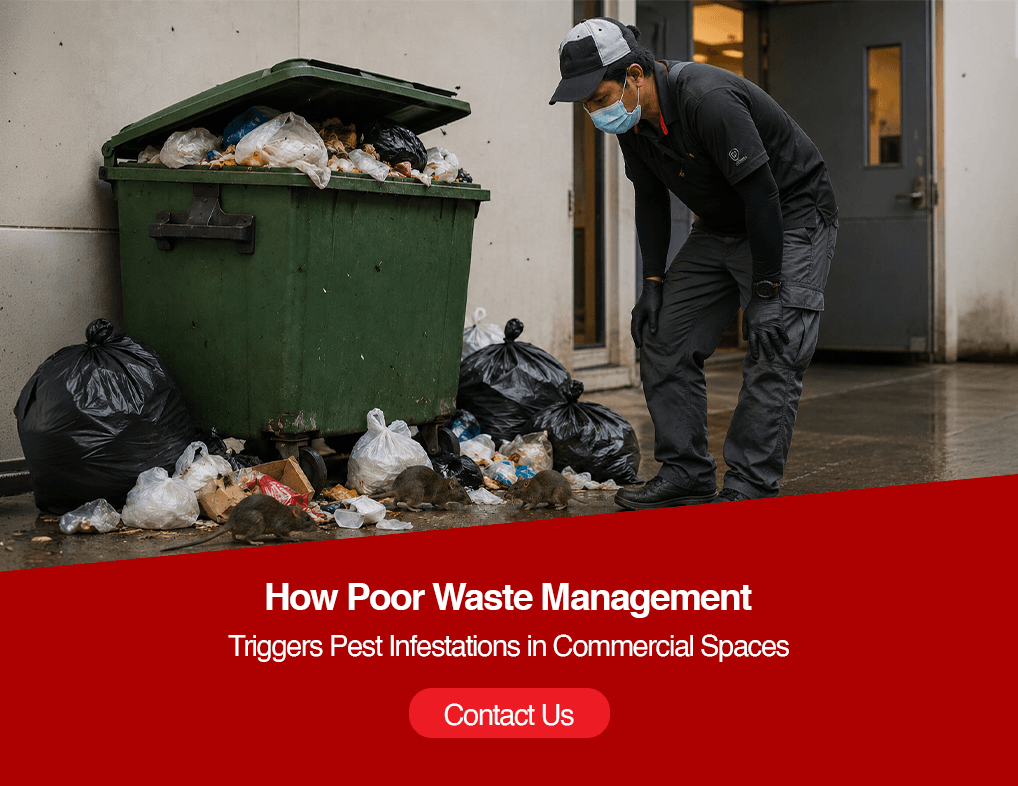
Most commercial pest problems do not begin with pests. They begin with conditions and poor waste management is one of the most reliable ways to create them. In commercial spaces, where organic waste is generated continuously and shared infrastructure is the norm, the gap between a clean facility and an active infestation can be surprisingly narrow. A single unsealed bin, an overflowing waste bay, or a neglected drain is often all it takes to give cockroaches, rodents, and flies exactly what they need to establish themselves.
The good news is that this is also one of the most preventable root causes of infestation. Unlike structural vulnerabilities that require significant remediation, waste handling failures are largely operational; they can be identified, corrected, and monitored with the right protocols in place. ORIGIN Exterminators‘ Integrated Pest Management (IPM) approach is built on precisely this logic: find the conditions that enable pest activity and address them before populations take hold. This article walks through why commercial spaces are particularly exposed, which pests are most directly linked to waste failures, what specific handling mistakes trigger infestations, and what practical steps supported by professional pest management can close the gap.
Why Commercial Spaces Are Especially Vulnerable
Commercial properties operate at a scale and intensity that residential spaces simply do not match. Restaurants turn over hundreds of covers a day, generating food scraps, packaging waste, and liquid residue throughout every service. Warehouses accumulate cardboard, pallets, and organic debris across vast floor areas. Office complexes with food courts, convenience stores, and shared kitchens produce consistent organic waste streams from early morning until late evening. The sheer volume of waste generated in these environments, combined with the pace at which it accumulates, means that even well-managed facilities face a persistent pest risk if their waste handling protocols are not deliberately structured around that reality.
What makes commercial spaces structurally more exposed than most operators realise is not just the quantity of waste it is the combination of factors that surround it. High foot traffic brings in pests from external environments. Shared access points, loading bays, and service corridors create multiple entry routes. Waste collection schedules are often fixed regardless of how much a facility produces on any given day, meaning overflow is a regular occurrence rather than an exception. Standard cleaning routines, focused on visible operational areas, frequently miss the waste infrastructure zones bin rooms, drainage channels, waste chutes where pest activity begins. Without a structured waste management protocol that accounts for pest risk, these gaps remain open.
High Waste Volume and Pest Opportunity
Restaurants, food courts, retail outlets, and office complexes produce organic waste at a rate that creates continuous opportunity for opportunistic pest species. Cockroaches, rodents, and flies do not require ideal conditions they require accessible ones. A bin that exceeds capacity by mid-afternoon, a waste bag left in a corridor during a busy service period, or a grease trap that is not emptied on schedule is sufficient to attract activity. Excess waste accumulation and overflowing bins are widely recognised as factors that increase pest attraction in food service environments, particularly for rodents, flies, and cockroaches.
The issue is compounded by the speed at which Singapore’s warm, humid climate accelerates organic decomposition. Waste that might remain relatively inert in cooler environments breaks down quickly here, intensifying odours and creating the moisture conditions that pests actively seek. This means the window between waste being deposited and it becoming a pest attractant is considerably shorter than many facility managers account for. Matching bin capacity and collection frequency to actual waste volumes not estimated averages is a practical first step that directly reduces this exposure.
Access Points Created by Poor Waste Practices
Waste that accumulates in corridors, near external walls, or around service infrastructure does more than attract pests it creates pathways for them to move deeper into a property. Rodents are particularly effective at following scent trails from waste accumulation points to internal areas, navigating through gaps around waste pipes, drainage channels, and bin store walls that are rarely treated as pest entry points. These structural gaps exist in virtually every commercial building, but they only become active infestation routes when waste handling practices give pests a reason to find and use them.
The problem is that waste infrastructure bin rooms, pipe penetrations, drainage systems tends to be treated as a separate domain from the main operational space. Maintenance teams focus on keeping kitchens, dining areas, and offices clean and functional, while waste areas are managed to a lower standard. Without a systematic inspection approach that explicitly links waste handling areas to structural vulnerabilities, these access routes remain open indefinitely. A pest management programme that does not assess bin room walls, drainage junctions, and waste pipe fittings as part of its scope is missing some of the most consequential entry points in the building.
Shared Facilities and Cross-Contamination Risk
Multi-tenant commercial buildings shopping malls, business parks, and mixed-use developments face a compounded version of this challenge. Shared waste infrastructure means that one tenant’s poor waste discipline can directly trigger pest activity that spreads to neighbouring units through shared corridors, utility ducts, ceiling voids, and drainage systems. Pests do not respect tenancy boundaries, and they are well-adapted to navigating the interconnected spaces that commercial buildings provide. By the time multiple tenants report sightings, the infestation is typically well-established and has moved well beyond its original source.
Property managers often respond to this reactively addressing complaints as they arise rather than implementing the coordinated approach that the shared environment requires. Centralised waste management policies, consistent bin protocols across all tenants, and coordinated pest monitoring that covers the building as a whole are substantially more effective than individual reactive responses. For property managers overseeing multiple commercial units, this is both a practical pest control consideration and a risk management one a shared infestation that affects multiple tenants carries reputational and contractual consequences that extend well beyond the cost of treatment.
Pest Species Most Linked to Waste Mismanagement
Not all pests respond equally to waste conditions. Certain species have a particularly strong biological drive toward the food sources, moisture, and harborage that poor waste management provides, and understanding which pests are most likely to appear and why helps commercial operators prioritise their prevention efforts. Rather than treating pest risk as a generalised concern, identifying the species most associated with specific waste failures allows for more targeted, effective intervention. In Singapore’s commercial environment, four pest types consistently emerge in connection with waste management breakdowns.
Each of these species has distinct behavioural characteristics that make it well-suited to exploiting the conditions that waste mismanagement creates. Recognising their early indicators is valuable, but the more important insight is understanding the waste conditions that draw them in because addressing those conditions is what prevents establishment rather than simply responding to it after the fact.
Rodents and Organic Waste Accumulation
Rats and mice are drawn to reliable food sources, and commercial waste bins provide exactly that. In Singapore’s climate, organic waste decomposes rapidly, intensifying odours that rodents can detect from considerable distances. Once a rodent establishes a feeding route near a waste area, the consequences extend well beyond the bin itself rodents will gnaw through packaging, contaminate stored goods, damage electrical wiring, and create nesting sites within walls, false ceilings, and insulation. What begins as a single animal following a scent trail from a loading bay can become a structural and hygiene problem within weeks.
ORIGIN’s RATSENSE® system an IoT-based rodent surveillance solution that provides continuous 24/7 monitoring has consistently identified loading bays and bin rooms as the most frequent initial activity zones in commercial rodent cases. This data-driven insight reinforces what behavioural science suggests: rodents establish feeding routes before they establish nesting sites, and those routes almost always originate near waste. Early detection at these entry points, before rodents move into operational areas, is significantly more effective than responding to sightings inside the building. RATSENSE® reduces the need for manual monitoring while providing real-time alerts that allow ORIGIN’s team to intervene at the earliest stage of activity.
Cockroaches Thriving in Waste Environments
German and American cockroaches are among the most common commercial pests in Singapore, and both species thrive where food residue and moisture are consistently present. Waste bins that are not cleaned regularly, floor drains with organic build-up, and grease traps near waste areas all serve as cockroach harborage and breeding sites. Cockroaches are nocturnal and adept at concealing themselves in tight spaces, which means a population can grow substantially before it becomes visible during operational hours. By the time staff begin reporting sightings, the infestation is typically far more extensive than it appears.
The reproductive capacity of cockroaches makes early intervention particularly important. A single female German cockroach can produce up to 300 offspring in her lifetime, meaning a small, undetected population near a waste point can become a full infestation within weeks. Waste environments provide not just food but the warm, humid, sheltered conditions that cockroaches require for breeding making poorly maintained bin rooms and drainage areas some of the most productive harborage sites in a commercial building. Addressing these environments through regular cleaning, structural maintenance, and targeted monitoring is far more effective than relying on periodic chemical treatments after populations are established.
Flies as Indicators of Waste Management Failure
Fruit flies and houseflies are often the first visible sign that waste management has broken down. They breed directly in decomposing organic matter food waste bins, floor drains, spilled liquids, and any surface where organic residue accumulates. Their lifecycle is rapid: under warm conditions, a fruit fly can complete development from egg to adult in as little as eight days, meaning populations can escalate quickly once a breeding site is established. In food service environments, this speed of reproduction makes fly activity a particularly urgent indicator that waste containment protocols need immediate review.
Beyond the visible nuisance, houseflies in particular are recognised as mechanical vectors capable of transferring pathogens from waste areas to food-contact surfaces. They can move contaminants between waste zones, preparation areas, equipment, and packaging, creating hygiene and food safety concerns that may not always be immediately visible. Persistent fly activity near food preparation areas may lead to adverse inspection findings and can raise concerns during HACCP or food safety audits if monitoring and corrective actions are inadequate. Treating fly activity as an early warning signal rather than a minor inconvenience, and tracing it back to its waste source, is the appropriate commercial response.
Specific Waste Handling Failures That Trigger Infestations
Pest infestations in commercial spaces rarely happen without a traceable cause. In the majority of cases, a specific waste handling failure whether a procedural gap, an infrastructure issue, or an oversight in staff practice creates the initial conditions for pest activity. The challenge is that these failures are often treated as minor operational issues rather than pest risk events, which means they persist long enough to enable infestation. Identifying and addressing these failure points is the foundation of any effective prevention strategy, and it is where the link between waste management and pest control becomes most practically actionable.
The failures outlined below are the most common and consequential ones observed in commercial environments across Singapore. They are not unusual or difficult to address but they require deliberate attention and accountability systems that many facilities have not yet built into their operational routines. Understanding them is the first step toward closing the gaps that pests consistently exploit.
Inadequate Bin Sealing and Waste Segregation
Open or poorly sealed bins are among the most direct triggers for pest activity. When organic waste is accessible without effort, pests face no barrier to feeding, breeding, and expanding their range. The solution sealed bins with secure lids that remain closed between deposits is straightforward, but it requires consistent enforcement. Bins that are left open because lids are broken, inconvenient, or simply not used as intended create a persistent attractant that no amount of chemical treatment will resolve while the condition remains.
Waste segregation failures compound the problem. Mixing food waste with general refuse increases the organic content in bins that may be collected less frequently, extending the window during which pests have access to food sources. Clearly labelled, purpose-specific bins with collection schedules matched to the waste type they hold are a basic but frequently overlooked control measure. In food service environments particularly, the separation of food waste from packaging and general refuse is not just a pest management consideration it is a hygiene standard that supports broader regulatory compliance.
Infrequent Collection and Overflow Situations
When waste collection schedules do not match the volume a commercial space actually produces, overflow becomes routine. Overflow means waste sits on floors, spills outside bin areas, and creates residue that persists even after the primary waste has been removed. This residue grease, food liquid, decomposing organic matter is enough to sustain pest populations between collection cycles, because it provides both nutrition and moisture in the concentrated form that pests seek. Facilities that experience regular overflow are effectively maintaining a pest attractant on a continuous basis, even if they believe their waste is being managed.
The practical fix is to treat overflow as a pest risk event rather than a logistical inconvenience. When bin capacity is regularly exceeded, the response should include both an immediate increase in collection frequency and a review of bin placement and capacity. Residue left after overflow should be cleaned thoroughly, including floor surfaces, drainage channels, and any wall or structural surfaces that waste has contacted. Integrating overflow monitoring into daily facility checks with a clear escalation process when thresholds are reached creates the accountability structure needed to prevent overflow from becoming a persistent condition.
Neglected Bin Rooms and Waste Infrastructure
Bin rooms and waste holding areas are among the most neglected spaces in commercial properties. They are operational necessities that rarely receive the same maintenance attention as customer-facing or food-handling areas, yet they function as the primary staging point for pest activity in many commercial buildings. Walls crack over time, drainage grates block with debris, and organic residue builds up in corners and along floor junctions creating ideal harborage conditions for cockroaches and rodents that persist regardless of how well the bins themselves are managed.
These areas are frequently excluded from standard cleaning schedules on the basis that they are considered outside the main operational space. In practice, a neglected bin room is a pest staging area from which infestations spread inward, following scent trails and structural gaps into kitchens, storage areas, and service corridors. Regular deep cleaning of bin rooms with particular attention to floor drains, wall junctions, and any gaps around waste infrastructure should be treated as an integral part of pest prevention, not a separate maintenance task. A quarterly structural review of waste areas, ideally coordinated with a pest management provider, keeps these spaces from becoming the infestation entry points they so easily become when left unattended.
The Business Consequences of Pest Infestations
For commercial operators, a pest infestation is not simply a hygiene problem to be resolved quietly. It carries direct operational, financial, and reputational consequences that can affect a business well beyond the immediate incident. In Singapore’s tightly regulated commercial environment, the regulatory framework around pest control and hygiene is robust and actively enforced, meaning that the cost of infestation extends into compliance exposure, potential licence risk, and public disclosure. Understanding the full business impact of pest activity helps decision-makers recognise pest management for what it is an operational necessity rather than a discretionary service.
The consequences are not abstract. They play out in inspection findings, social media posts, supply chain disruptions, and customer decisions. Businesses that treat pest management reactively responding to infestations after they occur consistently face higher costs, more disruptive interventions, and greater reputational exposure than those that invest in prevention. The economics of proactive pest management are straightforward: the annual cost of a structured programme is a fraction of the cost of a single significant infestation event.
Regulatory and Compliance Exposure
Singapore’s National Environment Agency holds commercial premises to strict hygiene and pest control standards, and enforcement is consistent. Serious or persistent pest infestations may result in enforcement action by the NEA, including fines, licence suspension, or temporary closure in severe cases. For businesses that have built their customer proposition around food quality and hygiene, a public inspection finding carries consequences that extend well beyond the immediate operational disruption.
For businesses operating under HACCP frameworks like food manufacturers, central kitchens and catering operations, significant pest control failures may result in audit non-conformities and could place food safety certification status at risk if not properly corrected and documented. For many businesses, the operational and reputational costs associated with a significant infestation can exceed the cost of maintaining a preventive pest management programme. ORIGIN’s HACCP-compliant services are designed precisely for these environments, providing the documentation, monitoring, and intervention protocols that support ongoing certification rather than reacting to the loss of it.
Reputational Damage in High-Visibility Sectors
In hospitality, food service, and retail sectors where customer experience is central to commercial success a pest sighting can cause lasting reputational damage that is disproportionate to the scale of the incident itself. Social media has fundamentally changed the speed and reach of these incidents. A single photograph of a rodent or cockroach in a dining area, posted publicly, can generate significant negative coverage within hours, reaching audiences that no marketing spend can quickly recover. The asymmetry between how long it takes to build a reputation and how quickly a pest incident can damage it is stark.
Brands that have invested years in building customer trust through food quality, service standards, and hygiene credentials can see that trust eroded rapidly by a single, preventable pest event. Prevention in this context is not just a practical pest control consideration; it is a brand protection strategy. The investment in a proactive, professionally managed pest programme is also an investment in maintaining the customer confidence that commercial success depends on. For businesses in high-visibility sectors, the reputational case for prevention is at least as compelling as the regulatory one.
Integrated Pest Management as the Structural Solution
Reactive pest control treating infestations after they appear addresses symptoms without resolving causes. For commercial spaces where waste management failures are the root trigger, this approach creates a cycle: conditions attract pests, treatment removes them temporarily, conditions remain unchanged, pests return. Breaking this cycle requires a methodology that addresses the environment, not just the pest population. Integrated Pest Management provides exactly this: a systematic, science-based approach that identifies the conditions enabling pest activity and intervenes before populations establish.
ORIGIN’s IPM framework combines structured inspection, continuous monitoring, root cause identification, and targeted intervention to support longer-term pest prevention beyond reactive treatment alone. deliver outcomes that reactive treatment cannot. Rather than applying uniform chemical treatments across a property on a fixed schedule, IPM directs attention toward the specific conditions including waste handling practices that create infestation risk. This makes pest management more efficient, more effective, and more durable, because it addresses the actual drivers of pest activity rather than managing their consequences.
Systematic Inspection Linked to Waste Risk Areas
IPM begins with a thorough inspection that maps pest risk against operational conditions, including waste handling practices, bin locations, collection schedules, and the physical condition of waste infrastructure. This is not a standard walkthrough of visible areas it is a structured assessment that identifies not just where pests are currently active, but where conditions make activity likely. Bin rooms, loading bays, drainage systems, and waste pipe routes are assessed as part of the risk profile, treated as pest risk zones rather than peripheral infrastructure.
This waste-aware inspection approach means that vulnerabilities are identified and addressed before they become infestation events. A cracked bin room wall, a blocked floor drain, or a gap around a waste pipe fitting that might be overlooked in a standard maintenance review becomes a documented risk point in an IPM inspection one that triggers a specific remediation recommendation. The result is a pest management programme that is genuinely preventive, because it is built on an accurate understanding of where and why pest activity is most likely to occur in that specific commercial environment.
The Pest Risk Matrix in Commercial Contexts
ORIGIN’s Pest Risk Matrix provides a structured scoring system that categorises pest threats by probability and potential damage. For commercial spaces with identifiable waste management weaknesses, this tool is particularly valuable because it brings analytical rigour to what might otherwise be a generalised concern. Rather than treating all pest risks as equally urgent, the matrix creates a prioritised view of which threats require immediate intervention and which can be managed through preventive controls allowing resources to be directed where they will have the greatest impact.
In practice, this means that a food court with a documented overflow problem and active fly activity will be assessed differently from an office building with a well-maintained bin room and no recent pest history, even if both are in the same commercial complex. The matrix provides the framework for making these distinctions systematically, ensuring that pest management decisions are driven by evidence and risk assessment rather than reactive responses to visible incidents. For facility managers and property operators who are accountable for pest control outcomes across multiple spaces, this structured approach provides both practical direction and a defensible audit trail.
Chemical-Free Controls That Target Root Causes
Where pest activity is linked to waste conditions, chemical treatments alone will not deliver lasting results. If the conditions that attract pests remain unchanged accessible food sources, moisture, harborage populations will return regardless of how effective the initial treatment was. This is the fundamental limitation of spray-and-repeat pest control, and it is why ORIGIN’s IPM methodology prioritises non-chemical interventions that address the environment rather than just the pest. Structural exclusion, harborage removal, targeted baiting, and monitoring technology work together to change the conditions that make a commercial space attractive to pests in the first place.
This approach is safer for staff and customers, reduces the chemical load in the operational environment, and produces more durable outcomes. For businesses in food service, healthcare, and hospitality where chemical exposure is a genuine concern and regulatory scrutiny is high, the chemical-free methodology is not just an environmental preference; it is a practical operational requirement. ORIGIN’s approach emphasises reduced chemical reliance through Integrated Pest Management principles and is supported by ISO 14001 environmental management certification and documentation practices aligned with food safety programme requirements.ORIGIN’s commitment to chemical-free approaches, backed by its ISO 14001 environmental certification and HACCP-compliant service protocols, ensures that pest management interventions do not introduce new risks while addressing existing ones. The goal is a commercial environment that pests find genuinely unattractive, not one that is periodically treated and temporarily cleared.
Practical Waste Management Steps That Reduce Pest Risk
Professional pest management and day-to-day waste handling discipline are most effective when they work from the same playbook. Monitoring technology, structural exclusion, and targeted intervention deliver their best results when the operational conditions that attract pests are being actively managed between service visits. The practical steps that reduce pest risk through better waste management do not require significant capital investment they require awareness, process clarity, and accountability systems that are consistently applied.
Implemented alongside a professional IPM programme, these measures substantially reduce the conditions that make commercial spaces attractive to pests. They also create a more accurate baseline for pest monitoring, because when waste management is well-controlled, any pest activity that does occur is more clearly attributable to a specific cause making it easier to identify, address, and prevent from recurring.
Bin Management Protocols That Close the Gap
Sealed bins with secure, functional lids, scheduled cleaning of bin areas, and collection frequencies matched to actual waste volumes are the operational baseline for effective pest prevention. These are not complex requirements, but they need to be formalised as protocols rather than left to individual discretion. When bin management is treated as a defined process with clear responsibilities, scheduled checks, and documented collection frequencies the gaps that pests exploit are far less likely to persist unnoticed.
Bin placement also matters more than is commonly recognised. Bins positioned away from building entry points, ventilation intakes, and food storage areas reduce the risk of pests moving from waste zones into operational spaces. Staff responsible for waste handling should understand that bin discipline is a hygiene and pest control function, not simply a tidiness requirement. Framing it this way and backing it with training and accountability checks changes the operational culture around waste handling in ways that directly support pest prevention outcomes.
Waste Area Maintenance as Pest Prevention
Bin rooms and waste holding areas should be included in regular deep cleaning schedules, with particular attention to floor drains, wall junctions, and any gaps around waste infrastructure. These are the areas where organic residue accumulates most persistently and where structural vulnerabilities are most likely to create harborage. Surface cleaning alone is not sufficient the corners, drainage channels, and pipe penetrations that are difficult to access require deliberate attention to prevent the build-up conditions that cockroaches and rodents exploit.
Cracks in bin room walls, poorly sealed pipe penetrations, and blocked drainage are structural issues that create harborage regardless of how well surface cleaning is maintained. A quarterly structural review of waste areas ideally coordinated with a pest management provider who can assess findings in the context of pest risk keeps these spaces from becoming infestation staging points. Treating waste area maintenance as part of pest prevention, rather than a separate facilities management task, ensures that the two functions reinforce each other rather than operating in isolation.
Staff Training and Accountability Systems
Waste management failures are often behavioural rather than infrastructural. Staff who are not trained to recognise the pest risk implications of waste handling gaps will not prioritise them not because
Frequently Asked Questions
Q: Why do cockroaches and rodents keep coming back even after my commercial kitchen gets treated?
A: If waste handling conditions like unsealed bins, organic residue in drains, or overflow aren’t corrected between treatments, pests simply return to the same attractants. Chemical treatments address the population, not the root cause.
Q: How quickly can a fly problem in a food court escalate into a serious infestation?
A: In Singapore’s warm climate, fruit flies can complete their lifecycle in as little as eight days, meaning a single neglected waste bin or floor drain can produce a visible infestation within weeks.
Q: Can one tenant’s poor waste habits cause a pest problem in neighbouring units of the same building?
A: Yes, pests move freely through shared utility ducts, ceiling voids, and drainage systems, so one tenant’s waste mismanagement can trigger infestations across multiple units in the same commercial building.
Q: How does ORIGIN Exterminators approach pest control differently from a standard spray treatment service?
A: ORIGIN’s Integrated Pest Management approach identifies the specific waste and environmental conditions driving pest activity rather than just treating visible populations, using tools like the IoT-based RATSENSE® monitoring system for early detection before infestations establish.
Q: What are the actual regulatory consequences for a Singapore food business found with an active pest infestation?
A: The NEA may take enforcement action against food businesses with serious or persistent pest infestations, including fines, licence suspension, or temporary closure in severe cases, and may publicly disclose certain inspection findings or enforcement outcomes. HACCP-certified operations may also face audit non-conformities and potential risk to certification status if pest issues are not effectively controlled and documented, along with additional scrutiny from supply chain or commercial partners.
Q: Is a blocked floor drain in a bin room really a significant pest risk, or is that overstated?
A: A blocked drain accumulates the organic residue and moisture that cockroaches and rodents actively seek for harborage and breeding, making it one of the most consequential and commonly overlooked pest risk points in a commercial property.
Q: What’s the minimum waste management standard a commercial facility should meet to meaningfully reduce pest risk?
A: At minimum, facilities need sealed bins with functional lids, collection frequencies matched to actual waste volumes, and regular deep cleaning of bin rooms including drains and wall junctions, all enforced as formal protocols with staff accountability.

