
Pest Activity Trends in Singapore by Industry
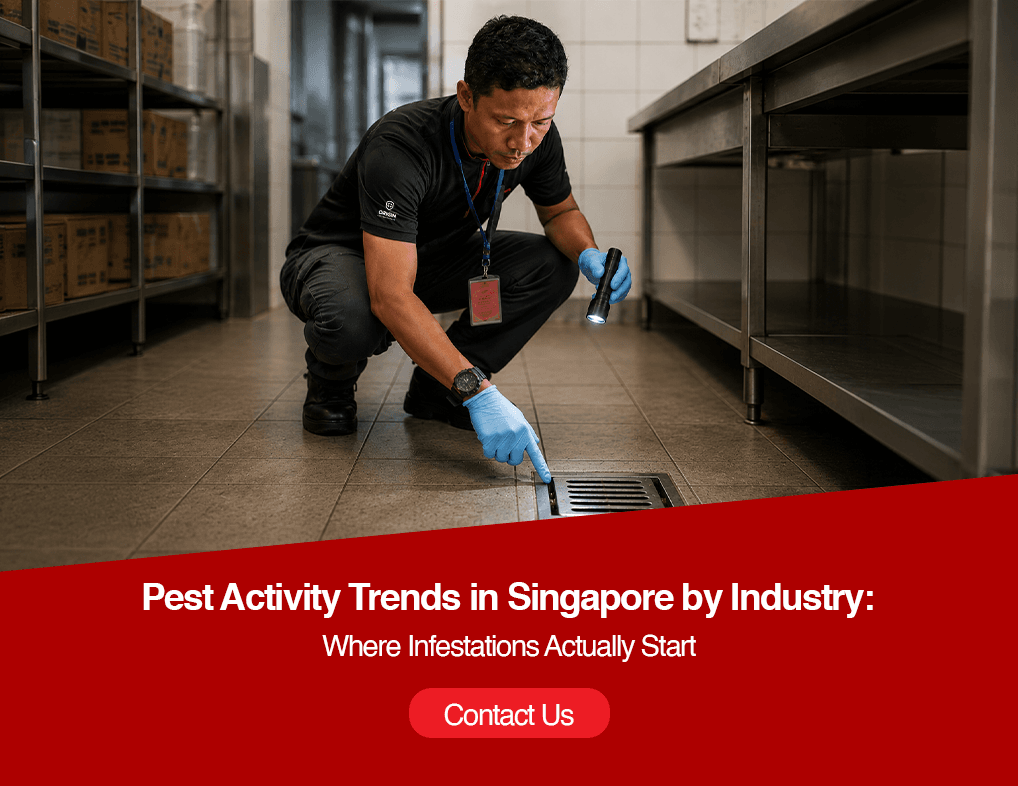
Pest activity trends in Singapore follow patterns that most facility managers and business owners never see coming because infestations rarely begin where they are eventually found. A cockroach spotted in a hotel corridor did not originate there. A rodent detected in a warehouse racking aisle has been active for weeks before anyone noticed. The real story starts much earlier, in overlooked corners of specific industries where conditions quietly favour pest establishment.
Singapore’s year-round humidity, dense urban infrastructure, and deeply interconnected supply chains make certain commercial sectors disproportionately vulnerable. The city-state’s built environment means pests do not need to travel far; shared drainage systems, riser ducts, and loading bays do the work for them. Understanding where pressure actually builds, by industry and by physical location, is the difference between a clean, compliant operation and a reactive scramble after the damage is done.
Drawing on over 35 years of observing pest behaviour across Singapore’s commercial and residential landscape, ORIGIN Exterminators has developed a clear picture of where infestations originate sector by sector. This blog moves through each industry in turn, identifying the actual entry points, explaining why those specific locations carry the highest risk, and outlining what a genuinely proactive response looks like. Whether you manage a food facility, a logistics hub, a hospital, or a residential estate, the insight here is practical and specific, not a generic pest awareness checklist.
Food and Beverage: The Highest-Risk Sector in Singapore
The food and beverage industry consistently sits at the top of Singapore’s pest activity data, and the reasons are structural rather than accidental. Commercial kitchens generate heat, moisture, food debris, and harborage opportunities simultaneously, a combination that attracts cockroaches, rodents, and flies in concentrated numbers. The physical layout of most commercial kitchens compounds the problem: equipment pushed against walls, undersink voids, and the space beneath cooking lines create undisturbed zones that pest populations exploit without interruption. Surface cleaning addresses visible contamination but leaves the structural conditions that sustain infestations entirely intact.
The sector’s vulnerability is further compounded by operational realities that have nothing to do with hygiene standards. High staff turnover means pest awareness is inconsistently applied. Waste management practices vary across shifts. Delivery schedules bring goods from multiple supply chain origins through the same access points every day, each shipment a potential introduction vector for stored-product pests or rodents. Grease traps, floor drains, and poorly sealed utility penetrations create persistent infestation corridors that no amount of scheduled spray treatment can close permanently. The only effective response is a monitoring-led approach that detects activity at the point of introduction before it migrates into food-contact zones because by the time a pest is visible in a food preparation area, the infestation is already established.
Delivery Bays and Dry Store Rooms as Entry Points
Goods-in areas are among the most undermonitored zones in any food and beverage operation, yet they represent the primary introduction point for a wide range of pest species. Cardboard packaging arriving from multiple suppliers carries cockroach egg cases in folded seams. Wooden pallets provide harborage for rodents during transit. Bulk dry goods like rice, flour, sugar, dried pulses can arrive with stored-product insect populations already active inside the packaging, invisible to visual inspection at receipt. Each delivery represents a fresh introduction risk, and in high-volume operations receiving multiple consignments daily, the cumulative exposure is substantial.
Dry store rooms compound the risk considerably. Irregular stock rotation leaves older product lines undisturbed for extended periods, allowing infestations to develop undetected. Poor ventilation creates the warm, humid microclimate that cockroaches and stored-product insects prefer. Proximity to drainage infrastructure means these rooms often share structural access points with the drainage network below floor level. Infestations that begin in dry stores frequently go undetected for weeks because visual inspection routines focus on food preparation areas rather than storage by which point the population has already dispersed. Targeted monitoring at goods-in and storage entry points, including IoT-based rodent surveillance such as RATSENSE®, intercepts activity at the source before it reaches food-contact zones where the regulatory and reputational consequences are far more serious.
Grease Traps and Drainage as Cockroach Highways
German cockroaches and American cockroaches exploit drainage systems with a degree of efficiency that surprises most operators encountering the problem for the first time. Grease traps that are not cleaned on a defined schedule accumulate organic matter at a rate that sustains large cockroach populations beneath floor level, entirely out of sight of routine inspections. These populations are not static; they migrate upward through floor drains into food preparation areas, particularly during quieter overnight periods when kitchen activity drops and the insects move more freely. The first visible sign is typically a few adults in the kitchen at opening time, but the population driving that activity can be hundreds of individuals living in the drainage infrastructure below.
The challenge for operators is that surface treatments applied to visible adults do not reach the harborage zone. Residual sprays applied to kitchen floors and walls kill foraging individuals but leave the breeding population in the drainage system entirely undisturbed, which is why cockroach activity recurs within days of treatment in operations relying on this approach. Effective control requires gel baiting programmes placed at drain entry points and targeted drain treatments that address the actual source of the population. ORIGIN’s Integrated Pest Management methodology identifies these ingress routes during systematic inspection treating the drainage infrastructure and harborage zones rather than managing visible adult activity as the primary problem. The distinction matters enormously for operators who have experienced recurring infestations despite regular pest control visits.
Why HACCP Compliance Demands Proactive Pest Management
HACCP certification requires pest management to function as a preventive control within the food safety system, not as a corrective action deployed after a sighting. This is a meaningful distinction that many operators underestimate until they face an audit. Auditors examine monitoring records, population trend data, and documented evidence of root cause analysis. They assess whether the pest management programme demonstrates ongoing surveillance and early detection capability. The question is not simply whether a pest control company visited the premises on schedule, it is whether the programme can show that pest activity was identified early, investigated at source, and corrected with documented outcomes.
F&B operators relying on reactive-only pest control approaches may face audit non-conformities if they cannot demonstrate adequate monitoring records, trend analysis, and corrective actions showing effective ongoing control. A visit record showing a technician attended and applied treatment tells an auditor very little about the current pest risk status of the facility. HACCP-aligned pest management programmes typically combine scheduled inspections, monitoring records, and documented corrective actions to support audit compliance and improve early detection of pest activity. The programme generates the trend data and root cause documentation that auditors require, rather than producing a service log that records activity without demonstrating control. The distinction between compliance theatre and actual pest management is increasingly apparent to experienced auditors, and the consequences of failing to demonstrate genuine control are significant for licensed food businesses in Singapore.
Warehousing and Logistics: Where Pests Travel Undetected
Singapore’s position as a regional logistics hub means warehouses process enormous volumes of goods from diverse geographic origins on a daily basis. This throughput creates a continuous pest introduction risk that static, perimeter-focused pest control programmes are structurally incapable of managing. Every inbound consignment from a different origin point carries the potential to introduce rodents, stored-product insects, or other hitchhiker pests into the facility. The challenge is not that warehouse operators are negligent, it is that the scale and pace of operations creates monitoring blind spots that traditional pest management approaches were never designed to address.
Rodents in particular exploit the structural characteristics of large warehouse environments with remarkable effectiveness. High racking systems create vertical harborage that is practically inaccessible to manual inspection. Infrequently moved stock lines provide undisturbed nesting sites. Multiple loading dock access points remain open for extended periods during operational hours, providing direct entry at ground level. The result is that rodent populations can establish and grow within a warehouse for weeks before any physical evidence is detected and by that point, product contamination, structural damage, and regulatory exposure have already occurred. Stored-product insects including weevils, beetles, and moths compound the problem by arriving embedded in consignments and spreading through adjacent product lines before visible adults appear. Technology-enabled surveillance that monitors continuously rather than periodically is the operational standard that logistics operators genuinely need.
Loading Docks as the Primary Rodent Entry Vector
Loading docks present the most direct rodent access point in any warehouse environment, yet they are frequently the least effectively monitored zone in a facility’s pest management programme. Dock levellers create floor-level gaps that rodents exploit during low-traffic periods. Gaps around roller doors, even when doors are nominally closed, provide sufficient clearance for a rat or mouse to pass through. The constant movement of vehicles, personnel, and goods means these access points cannot be permanently sealed, and the organic debris that accumulates around dock areas like spilled product, packaging residue, food waste from staff areas provides the sustenance that keeps rodents returning once they have identified the location as a reliable food source.
Once inside, the racking environment provides harborage that traditional snap-trap programmes placed at perimeter points are poorly positioned to address. Rodents that have established interior runs are not reliably intercepted by perimeter traps they are already living and feeding well inside the trap line. RATSENSE® smart surveillance deployed at loading dock zones and interior activity points identifies active movement corridors and infestation severity through continuous monitoring, allowing ORIGIN’s team to deploy targeted interventions at confirmed activity locations. Rather than guessing based on infrequent manual checks, the response is driven by real-time data which means the intervention happens at the right place, at the right time, before the population reaches a scale that creates regulatory or client audit exposure.
Stored-Product Insects and the Supply Chain Problem
Infestations of grain weevils, flour beetles, and tobacco beetles rarely originate within the warehouse itself they arrive inside incoming consignments from suppliers. This is a supply chain problem as much as a pest management problem, and it requires a response that begins at goods receipt rather than after visible adults appear in stock. By the time warehouse staff notice adult insects on shelving or in product lines, the infestation has typically been active for several weeks. Stored-product insects complete life cycles within packaging material, meaning the population visible on the surface represents only a fraction of the total activity occurring inside product lines. Spread to adjacent consignments happens quickly in a shared storage environment.
Effective control requires inspection protocols applied at the point of goods receipt, not reactive treatment after detection. Pheromone monitoring traps placed strategically through storage aisles provide early population data that identifies problem areas before infestation spreads across multiple product lines. When combined with supplier audit requirements specifying pest management standards for goods-in facilities and clear quarantine procedures for suspect consignments, warehouses can intercept infestations before they enter the distribution chain. This approach protects not only the warehouse operator’s own stock but also the clients and retailers receiving goods from the facility, whose confidence in the supply chain depends on consistent pest management standards being applied upstream.
Reducing Manpower Costs Without Reducing Coverage
Large warehouse footprints make traditional pest management both labour-intensive and structurally inconsistent. A manual inspection of a 50,000 square foot facility cannot realistically cover every racking aisle, structural void, ceiling space, and loading dock area within the time constraints of a standard service visit. The practical result is that inspection coverage is concentrated in accessible, visible areas while the zones most likely to harbour established pest activity high racking, infrequently moved stock, structural voids receive minimal attention. This creates a false assurance of coverage that does not reflect the actual monitoring status of the facility.
RATSENSE® addresses this directly by handling 80% of monitoring tasks remotely through continuous IoT-based surveillance, with technician visits focused on confirmed activity zones rather than routine walkthroughs of the entire floor space. The system reduces manpower requirements by 50% while increasing capture effectiveness by 30% a meaningful efficiency gain for logistics operators managing tight operational budgets where pest management is viewed as a cost centre rather than a risk management investment. The financial case is straightforward: fewer unnecessary routine visits, targeted responses at confirmed activity points, and a continuous data trail that satisfies regulatory requirements and client audit demands simultaneously. For property managers and logistics operators responsible for multiple facilities, the centralised reporting capability simplifies oversight considerably.
Hospitality Sector: Reputation Risk Starts in Hidden Spaces
Hotels, serviced apartments, and resorts face a pest challenge that is fundamentally different from other commercial sectors: the consequences are public, immediate, and reputationally damaging in ways that other industries rarely experience. A single verified bed bug incident in a guest room can generate online reviews that affect occupancy rates for months. A cockroach sighting in a dining area triggers regulatory attention and social media exposure within hours of the incident. The hospitality sector operates in a visibility environment where pest activity is never a private operational matter it becomes public knowledge almost immediately, and the reputational recovery is slow and expensive.
The sector’s structural vulnerability stems from several converging factors. Guests and their luggage arrive continuously from global origins, each carrying the potential to introduce bed bugs, stored-product pests, or other hitchhiker species. The physical complexity of large hotel properties multiple building services, interconnected kitchen and laundry infrastructure, extensive soft furnishings across hundreds of guest rooms creates monitoring challenges that standard inspection routines cannot adequately address. Operational pressure to minimise service disruption means pest management is often scheduled around guest activity rather than pest behaviour cycles, which is rarely the optimal timing. Pest activity in hotels characteristically originates in laundry facilities, kitchen loading areas, and guest room soft furnishings not in the lobby or public spaces where most visual checks are concentrated.
Bed Bug Introduction Through Guest Luggage and Linen
Bed bugs are almost exclusively introduced into hotel environments through human movement, which makes them a structurally unavoidable risk for any property receiving guests from multiple origins. Luggage placed on upholstered surfaces, infested linen from previous guests, and second-hand furniture acquisitions are the primary introduction vectors. The biology of bed bugs makes them particularly difficult to manage through standard housekeeping protocols: they are cryptic, nocturnal, and capable of surviving for months without feeding, which means a low-level introduction can persist undetected through multiple room turnovers before any guest complaint triggers investigation.
Early detection requires systematic inspection of the specific harborage zones where bed bugs establish mattress seams, headboard joints, the underside of bed bases, and the interior structure of bedside furniture. These are not areas that standard housekeeping checks cover during room preparation. ORIGIN’s inspection protocols target these precise locations during routine service visits rather than waiting for a guest complaint to initiate investigation. By the time a guest reports a bite or a visible insect, the population has typically been present for several weeks and may have spread to adjacent rooms through shared wall voids or housekeeping equipment. Catching activity at the introduction stage, before it becomes a reportable incident, is the only approach that protects both guests and the property’s online reputation.
Kitchen and Laundry Infrastructure as Cockroach Harborage
Large hotel kitchens share the same structural vulnerabilities as commercial food and beverage operations grease accumulation, drainage complexity, and consistently high moisture levels but at considerably greater scale. A hotel kitchen serving hundreds of covers per service generates the organic debris and drainage conditions that sustain cockroach populations at volume. The challenge is compounded by the operational intensity of hotel food service: kitchens running from early breakfast through late evening service leave minimal windows for thorough treatment without disrupting food production, which means pest management visits are often compressed into early morning slots that do not align with peak cockroach activity periods.
Laundry facilities add a secondary and frequently overlooked risk. The warm, humid environment of a commercial laundry operation, combined with organic material residue in drainage systems from soiled linen processing, creates cockroach harborage conditions that are structurally similar to kitchen drainage infrastructure. Cockroach populations established in laundry drainage can migrate through shared service corridors into guest floors, particularly in properties where laundry and kitchen areas share building services infrastructure. Hotels that treat kitchen and laundry pest management as entirely separate programmes often miss the connective infrastructure between them the shared riser ducts, drainage runs, and service corridors through which pest populations move between zones. An integrated approach that maps pest movement through building services rather than treating zones in isolation produces cleaner audit outcomes and more reliable pest suppression across the property.
Healthcare Facilities: Zero Tolerance Requires Smarter Detection
Hospitals, clinics, and care facilities operate under the strictest hygiene standards in Singapore’s commercial landscape, yet pest activity in these environments is more common than reported figures typically suggest. The consequences of infestation in healthcare settings extend well beyond regulatory penalties and reputational damage: pest activity near sterile zones, patient wards, or pharmaceutical storage creates direct health risk to vulnerable populations. Rodents gnaw electrical wiring, contaminate surfaces, and introduce pathogens that carry serious implications in clinical environments. Cockroaches carry bacteria associated with healthcare-acquired infections a risk category that infection control teams work to eliminate through multiple operational systems, only to have pest activity undermine those efforts from an unexpected direction.
The operational challenge in healthcare pest management is that the standard treatment toolkit available in commercial settings is not applicable in occupied clinical areas. Broad-spectrum residual insecticide treatments cannot be used in patient wards, sterile preparation areas, or pharmaceutical storage zones. Patients with compromised immune systems, infants in neonatal units, and individuals with respiratory conditions face direct risk from chemical exposure that would be considered routine in other commercial environments. This makes chemical-free and targeted methodologies not merely preferable in healthcare settings but operationally necessary the absence of a viable chemical option means the pest management programme must achieve effective suppression through other means, and it must do so without disrupting patient care or creating compliance documentation gaps. Pest entry in healthcare settings most commonly originates in waste management areas, food service kitchens, and building service ducts.
Clinical Waste Areas and Kitchen Zones as Infestation Origins
Clinical and food waste in healthcare facilities creates sustained pest pressure at collection points that operates at a different intensity than equivalent commercial settings. Waste holding areas that are not sealed, temperature-controlled, or cleared on tight schedules attract flies, rodents, and cockroaches at elevated rates. The organic content of clinical waste dressings, food residue from patient meals, pharmaceutical packaging provides a nutrient-rich environment that sustains pest populations even when ambient food sources elsewhere in the facility are well controlled. In large hospital complexes, the distance between clinical waste generation points and external collection areas means waste moves through building corridors, creating a trail of pest pressure that extends well beyond the holding area itself.
Hospital kitchens serving large patient populations generate the same structural risks as commercial food service operations heat, moisture, grease accumulation, and drainage complexity with the added operational constraint of 24-hour service. A hospital kitchen cannot be closed for treatment in the way that a restaurant can schedule an overnight service. Treatment windows are narrow, access is restricted during meal preparation and service periods, and the consequence of any treatment residue reaching patient food is unacceptable. Monitoring programmes that operate continuously rather than during scheduled service visits are the only realistic mechanism for detecting activity in these high-risk zones without disrupting patient care. Real-time surveillance data allows interventions to be scheduled precisely within available windows rather than on a calendar basis that may not align with actual activity levels.
Why Chemical-Free Methods Are Non-Negotiable in Clinical Spaces
Standard residual insecticide treatments are incompatible with occupied ward environments, sterile preparation areas, and pharmaceutical storage zones this is not a preference but a clinical requirement. Patients with compromised immune systems face direct risk from chemical exposure that would be considered entirely routine in a commercial kitchen or warehouse setting. Neonatal units, oncology wards, and intensive care environments require pest management approaches that achieve effective suppression without leaving any chemical residue in spaces where vulnerable patients are present continuously. The pest management provider operating in these environments must be able to demonstrate not only that their methods are effective but that they are genuinely safe for the specific patient populations in the facility.
ORIGIN’s chemical-free IPM approach uses targeted baiting, mechanical trapping, and biological controls that achieve effective pest suppression without chemical residue in sensitive areas. This methodology is grounded in pest biology and behavioural science understanding where pests harbour, how they move through a facility, and what conditions sustain their populations rather than relying on chemical knockdown as the primary control mechanism. ISO 14001 and ISO 45001 certifications are commonly used as supporting evidence of structured environmental and occupational safety management systems during vendor evaluation and procurement processes, including in some healthcare and institutional tenders. In most Singapore hospital procurement frameworks, these certifications are not optional extras they are baseline requirements, and the ability to demonstrate genuine chemical-free methodology through documented service records is increasingly scrutinised during vendor assessment.
Discreet Service Delivery in Occupied Facilities
Pest management in active clinical environments requires a level of scheduling precision, operational communication, and coordination that most pest control providers are not structured to deliver consistently. Treatments must occur without disrupting patient care routines, alarming visitors in waiting areas, or creating the kind of visible pest management activity that undermines patient confidence in the facility’s hygiene standards. A technician arriving with equipment and moving through a ward during visiting hours creates an operational and reputational problem that is entirely avoidable with proper service coordination but avoidable only if the provider has the systems and protocols to manage it.
ORIGIN’s service protocols for healthcare clients include defined treatment windows agreed in advance with facility management, technician conduct standards appropriate to clinical environments, and real-time reporting that integrates with facility management records and infection control documentation. The result is pest management that functions as a background operational system present, effective, and continuously active rather than a reactive emergency response that arrives visibly and disruptively after a sighting has already been reported. This is the operational standard that healthcare facilities actually require, and it demands a provider with the organisational structure and service discipline to deliver it consistently across every visit, not just during initial contract mobilisation.
Commercial Properties and Mixed-Use Developments: The Shared Infrastructure Problem
Multi-tenanted commercial buildings, mixed-use developments, and managed residential estates present a pest management challenge that single-tenancy properties do not face: infestation in one unit creates measurable risk for every adjacent unit in the building. Rodents and cockroaches move freely through shared drainage systems, riser ducts, and ceiling voids regardless of which tenant’s lease boundary they happen to cross. The pest population does not observe tenancy agreements, and a treatment applied within one unit boundary does nothing to address the source population moving through the shared building infrastructure that connects every floor.
Property managers who rely on individual tenants to arrange their own pest control create fragmented coverage with predictable gaps. A ground-floor food and beverage tenant may engage a pest management provider, but if the adjacent retail unit and the residential floors above are operating separate or no pest management programmes, the building’s shared infrastructure remains an active infestation corridor regardless of what any individual tenant does within their own space. Singapore’s high-density built environment makes this a structural issue affecting the majority of commercial properties rather than an edge case. Effective pest management for commercial properties requires a building-wide programme with centralised monitoring, coordinated treatment schedules, and clear accountability not a patchwork of individual service contracts that collectively leave the most important zones unmanaged.
Shared Drainage and Riser Ducts as Movement Corridors
Cockroaches and rodents exploit shared building infrastructure with an efficiency that makes individual unit treatments a fundamentally inadequate response to building-level infestations. A ground-floor food and beverage tenant with an active cockroach population will push insects upward through riser ducts into office floors above when surface treatments are applied within the unit the treatment displaces the population rather than eliminating it, and the displacement moves the problem into areas where no pest management programme is active. This is a predictable outcome of treating individual units in isolation, yet it remains a common pattern in multi-tenanted buildings across Singapore.
Rodents use ceiling voids and drainage runs to access multiple floors from a single ground-level entry point, establishing runs through building infrastructure that individual unit treatments cannot intercept. A rodent entering through a basement carpark or ground-floor bin centre can establish activity on multiple floors within days, using the building’s own structure as a movement network. Property managers who understand this dynamic invest in building-wide monitoring programmes that map pest movement through shared infrastructure tracking where pressure originates and how it moves through the building rather than responding to individual tenant complaints in isolation after the population has already dispersed through multiple floors.
Centralised Monitoring as the Practical Solution
RATSENSE® surveillance deployed at building level covering loading bays, basement carparks, bin centres, and riser access points gives property managers a unified picture of rodent activity across the entire asset rather than a fragmented collection of individual unit reports. Data is transmitted in real time, alerts are generated at confirmed activity points, and service visits are triggered by evidence of activity rather than calendar schedules that may or may not align with actual pest pressure at any given time. This approach eliminates the routine visits that generate cost without generating value while ensuring that genuine activity receives a rapid, targeted response at the confirmed location.
Frequently Asked Questions
Q: Why do pest infestations in Singapore’s F&B sector keep coming back even after regular pest control treatments?
A: Recurring infestations almost always mean the breeding population in drainage systems and structural voids is never actually reached by surface treatments, only the foraging adults are killed. Addressing grease traps, floor drains, and harborage zones at source is what breaks the cycle, not increasing spray frequency.
Q: How do warehouses in Singapore end up with rodent problems despite having pest control in place?
A: Most warehouse pest programmes focus on perimeter trap lines, but rodents that enter through loading docks quickly establish interior runs well inside that trap boundary, making perimeter-only monitoring structurally ineffective. Continuous surveillance at loading dock zones and confirmed interior activity points, like ORIGIN Exterminators’ RATSENSE® system, intercepts populations before they reach that scale.
Q: At what point in a hotel operation do bed bug infestations typically start, and how early can they be caught?
A: Bed bugs almost always enter through guest luggage or infested linen and establish in mattress seams, headboard joints, and bed base undersides long before any guest complaint surfaces. Systematic inspection of those specific harborage points during routine service visits, rather than waiting for a reported bite, is the only realistic early detection approach.
Q: Can pest activity in one unit of a commercial building realistically spread to other floors or tenants?
A: Yes, cockroaches and rodents move freely through shared riser ducts, drainage runs, and ceiling voids with no regard for lease boundaries, meaning a treatment applied within one unit often just displaces the population into adjacent unmanaged spaces. Building-wide monitoring that tracks pest movement through shared infrastructure is the only approach that addresses the actual source rather than shifting the problem.
Q: Why can’t hospitals in Singapore use standard insecticide treatments the same way commercial kitchens do?
A: Occupied wards, sterile preparation zones, and pharmaceutical storage areas cannot safely receive residual chemical treatments because patients with compromised immunity, respiratory conditions, or critical care needs face direct health risk from exposure that would be routine elsewhere. This makes chemical-free IPM methods using targeted baiting, mechanical trapping, and biological controls an operational requirement rather than a preference in clinical settings.
Q: What makes dry store rooms in food businesses such a high-risk origin point for infestations?
A: Poor stock rotation leaves older product lines undisturbed for weeks, irregular ventilation creates the warm humid conditions cockroaches and stored-product insects prefer, and proximity to drainage infrastructure provides direct structural access from below floor level. By the time activity is spotted in a preparation area, the infestation in the dry store has typically been established and dispersing for some time.
Q: How does a HACCP audit actually assess whether a pest management programme is working, beyond just checking service visit records?
A: Auditors assess pest management effectiveness through monitoring records, corrective actions, and evidence that issues are identified and resolved in a timely manner. In stronger programmes, trend analysis and root cause investigation are used to demonstrate ongoing control, rather than relying solely on service visit logs.

